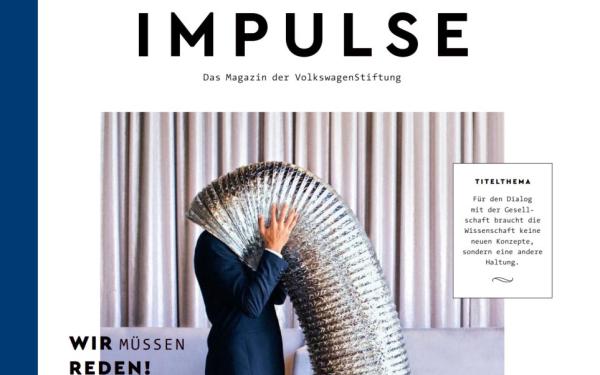
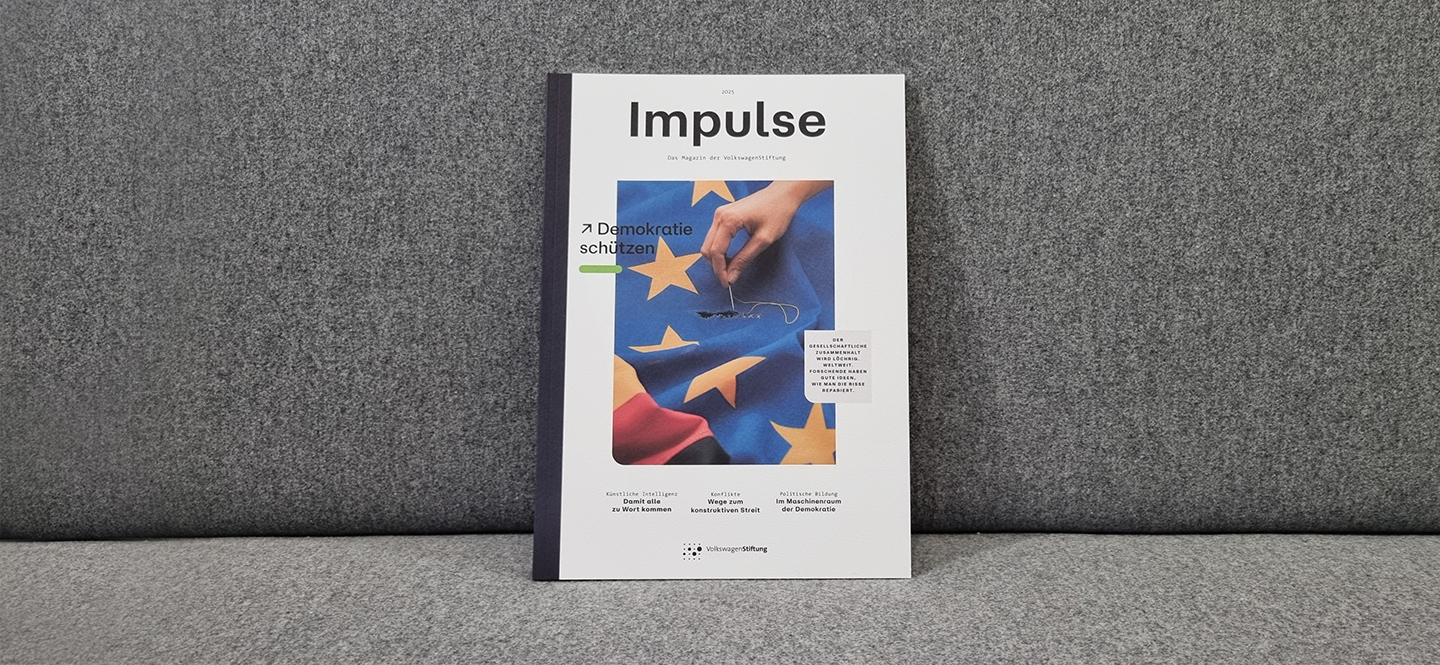
Now online: IMPULSE magazine "Protecting democracy" (in German)
VolkswagenStiftung
What holds our society together in the face of the crisis of democracy? What concepts does science offer us to keep democracy strong and vibrant? We explore these questions in the latest issue of our magazine IMPULSE (in German).
From citizens' assemblies to democracy education – researchers funded by us are working on numerous current issues in the field of democracy, developing coherent recommendations on how it can be protected and strengthened.
More on Democracy & Science
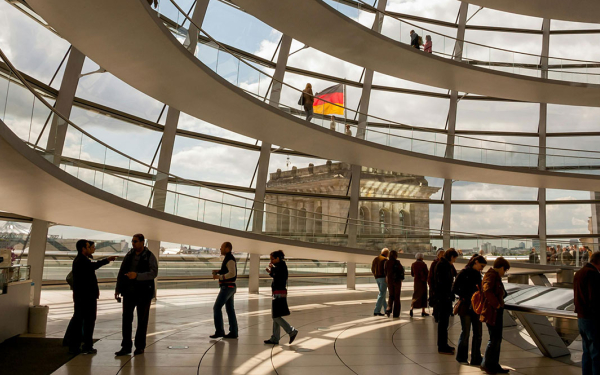
We have compiled portraits of researchers, reports on research projects, interviews, funding programmes and events on the topic for you on our constantly expanding #Democracy & Science page.




Order your free copy
Would you like to receive the printed edition of the current IMPULSE 2025 free of charge? Then send an e-mail with your postal address and the subject "Impulse 2025" to Birgit Schulz, schulz(at)volkswagenstiftung.de.
IMPULSE magazine: Transdisciplinarity
#Transdisciplinarity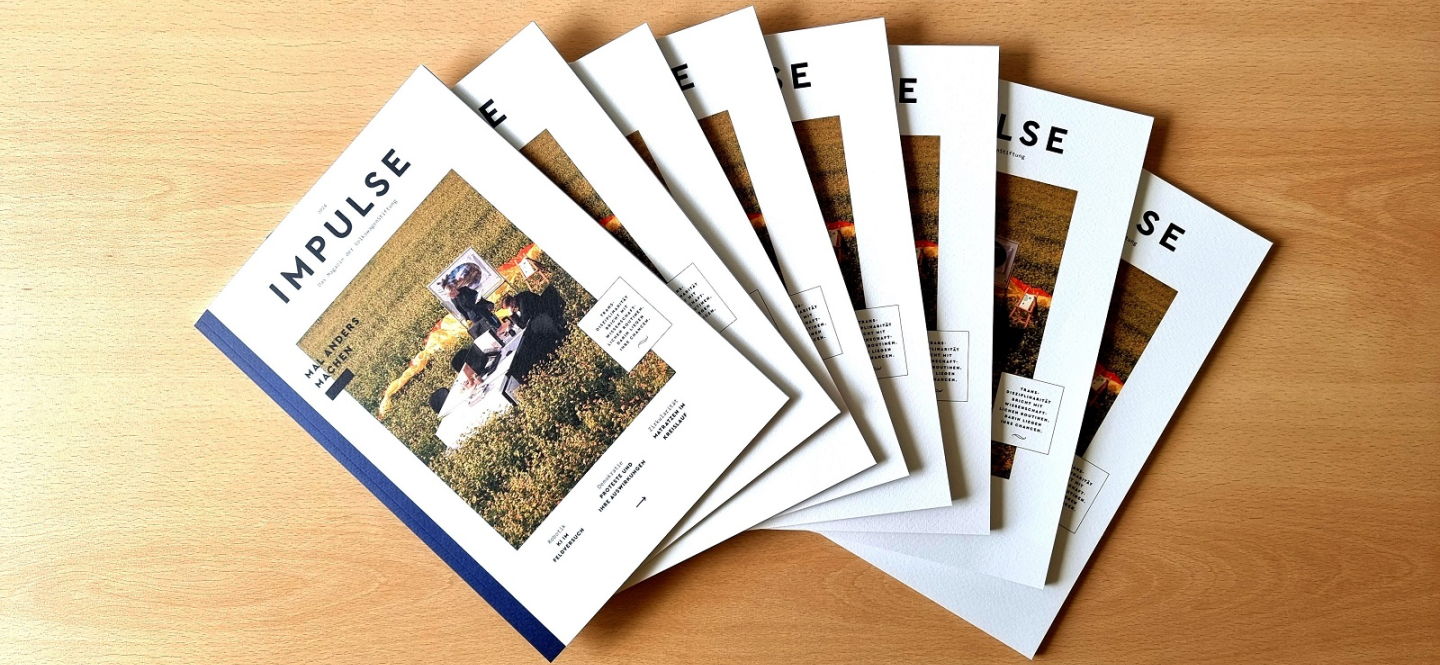
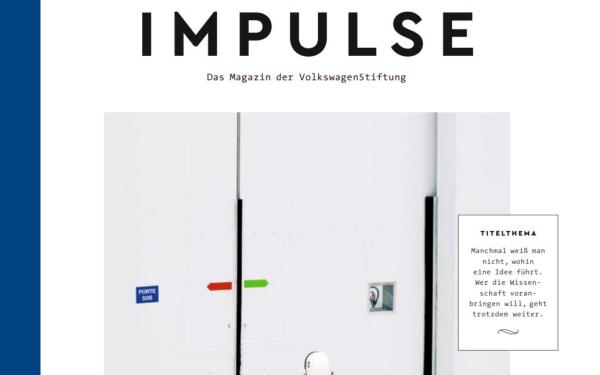
When researchers integrate representatives from other areas of society into their scientific work, new perspectives emerge and it becomes easier to 'do things differently'. In our magazine IMPULSE 2024, we introduce people who take on this challenge out of conviction. Read their stories in the PDF - or request a free printed copy (in German, only).
For the articles in the magazin IMPULSE 2024, we asked journalists to talk to the creative minds that we support. Under the title "Mal anders machen" ("Doing things differently"), the magazine brings together a wide range of projects, topics and people who are challenging the status quo with their research and discovering new solutions by integrating other perspectives.
Would you like to receive the current issue of Impulse (in German) free of charge? Order the print edition of the magazine by emailing Birgit Schulz with your postal address: schulz(at)volkswagenstiftung.de. Or read the magazine in PDF format:





status 2024 – Annual Report of the Volkswagen Foundation
VolkswagenStiftung
In 2024, the Volkswagen Foundation approved 728,8 million euros for scientific projects. Figures, data and facts from our 2024 annual report.
At a glance: The most important figures, data and facts
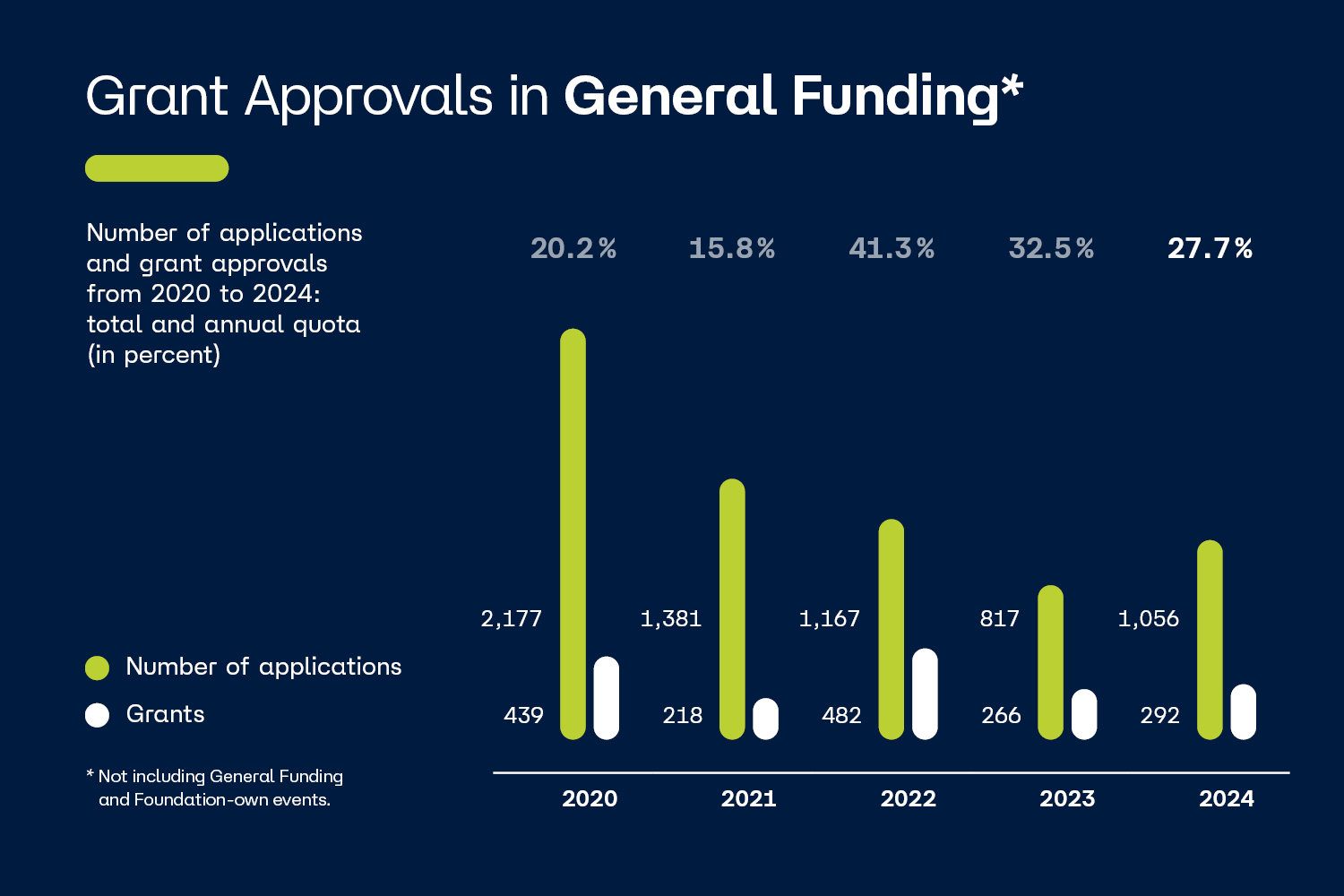
Number of applications and grant approvals (general funding) from 2020 to 2024
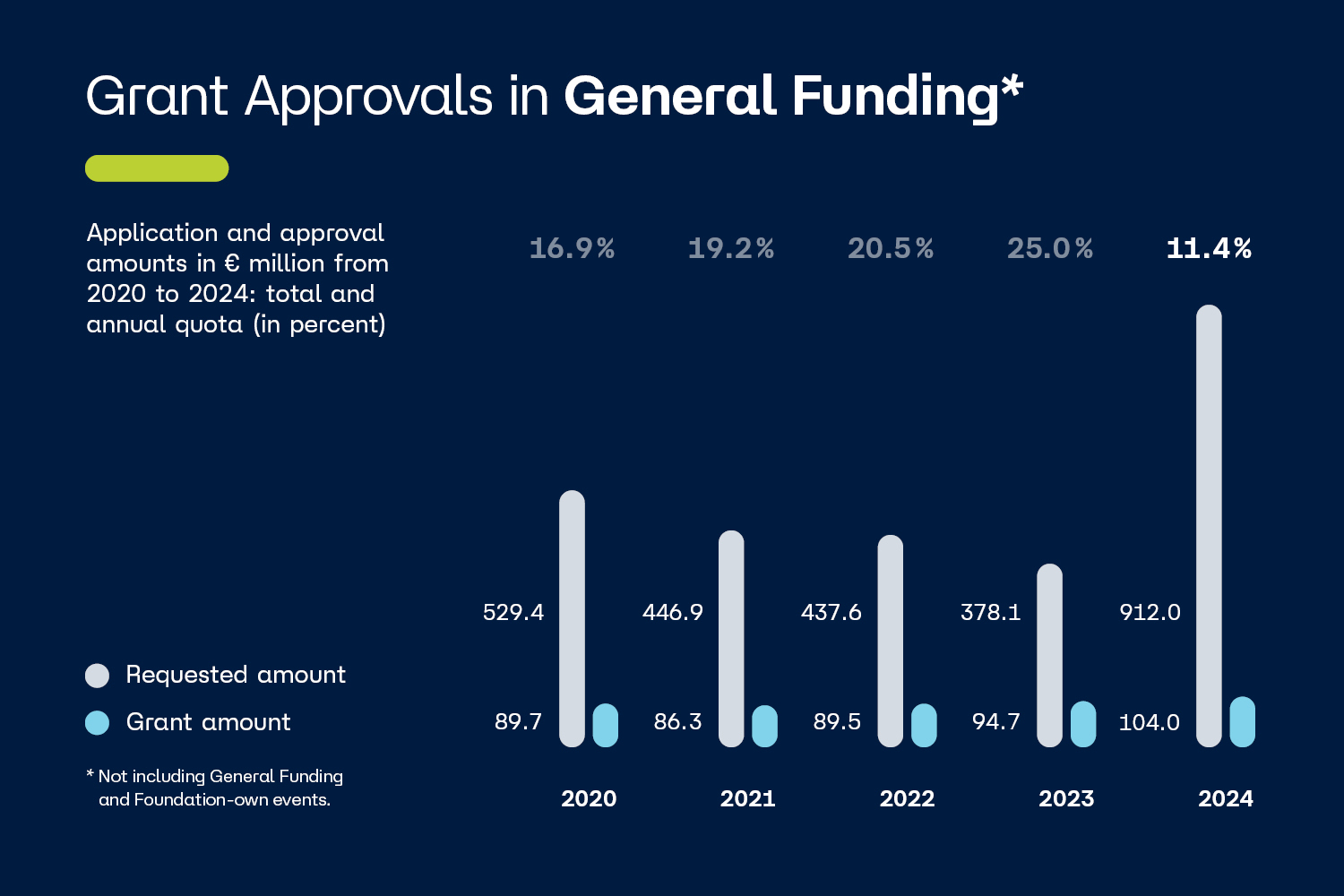
Application and approval totals for general funding from 2020 to 2024
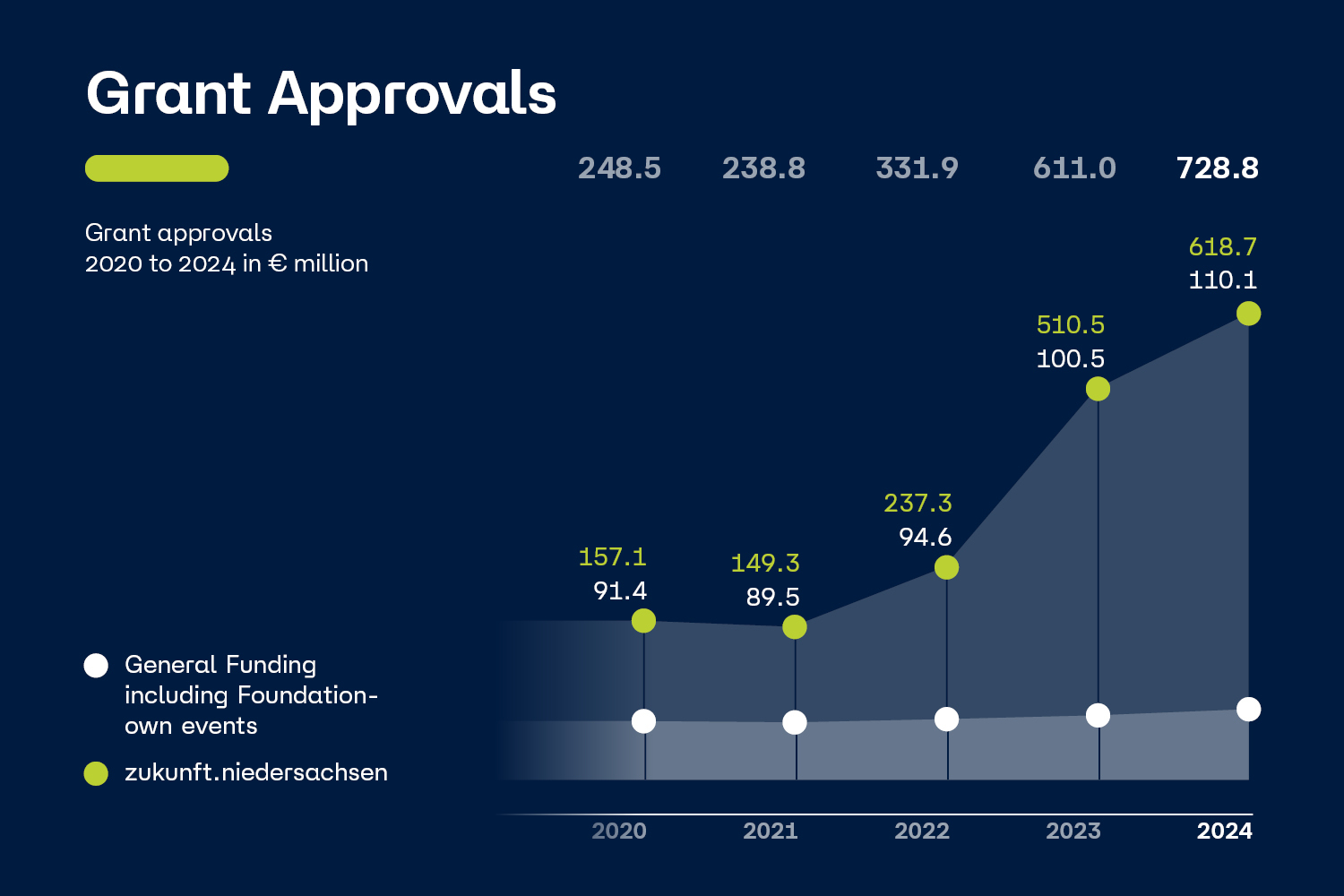
Grant approval totals for the years 2020 to 2024 in general funding (including the foundation's own events) and in the zukunft.niedersachsen programme
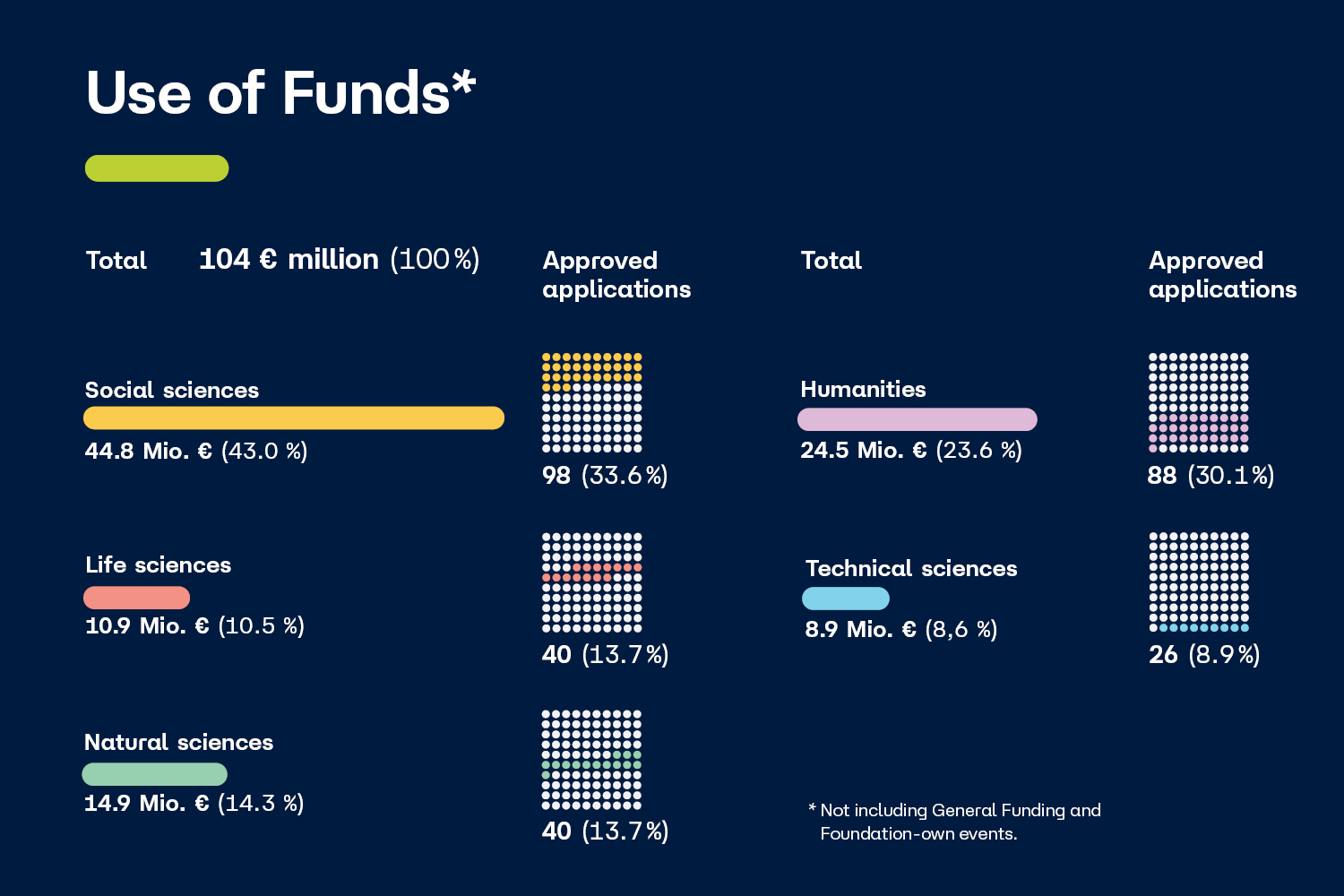
The total of 292 approvals in general funding in 2024 presented by scientific discipline, number, funding amount and the percentage share of approvals and funding amount in total.
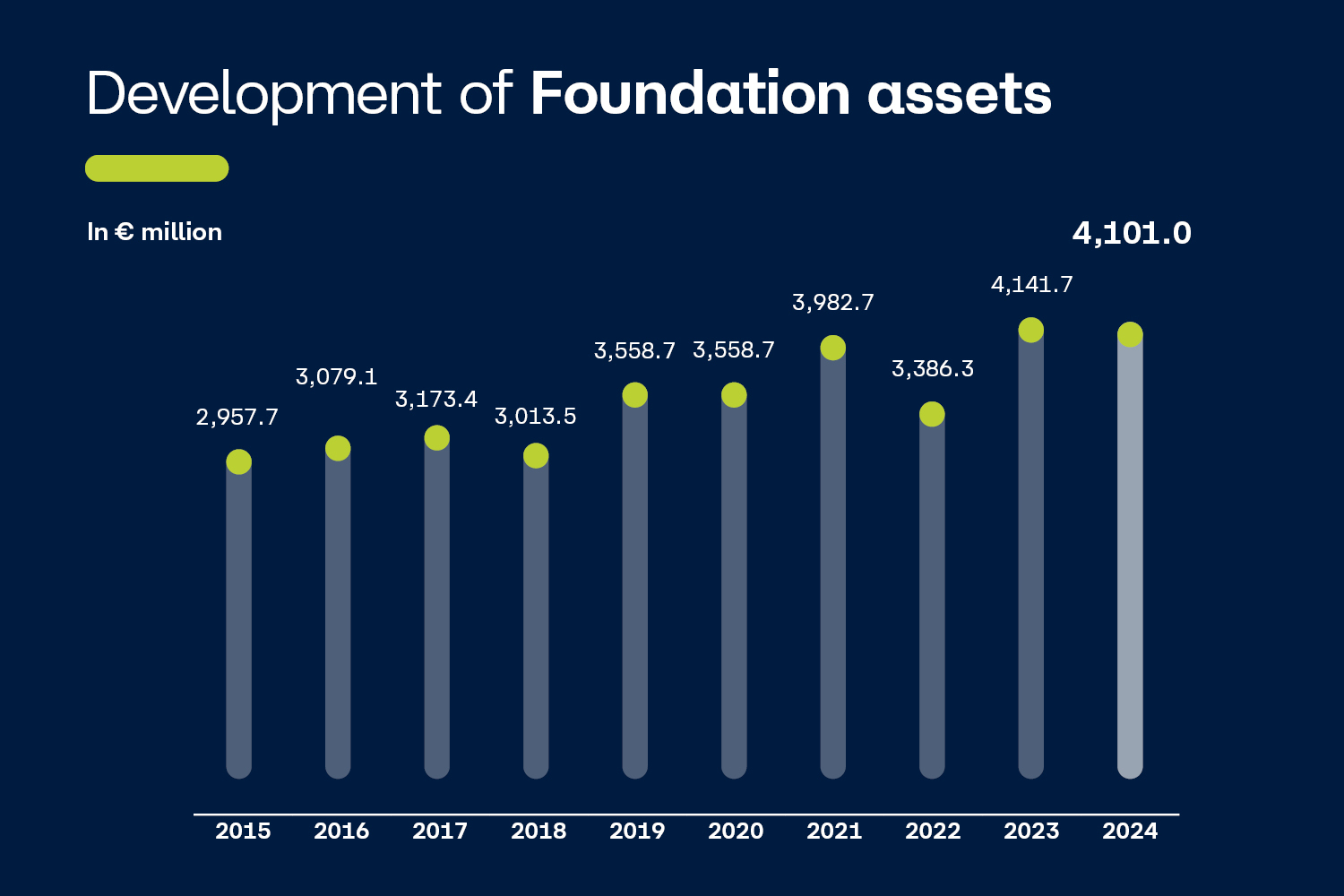
Development of the foundation's assets over the past 10 years
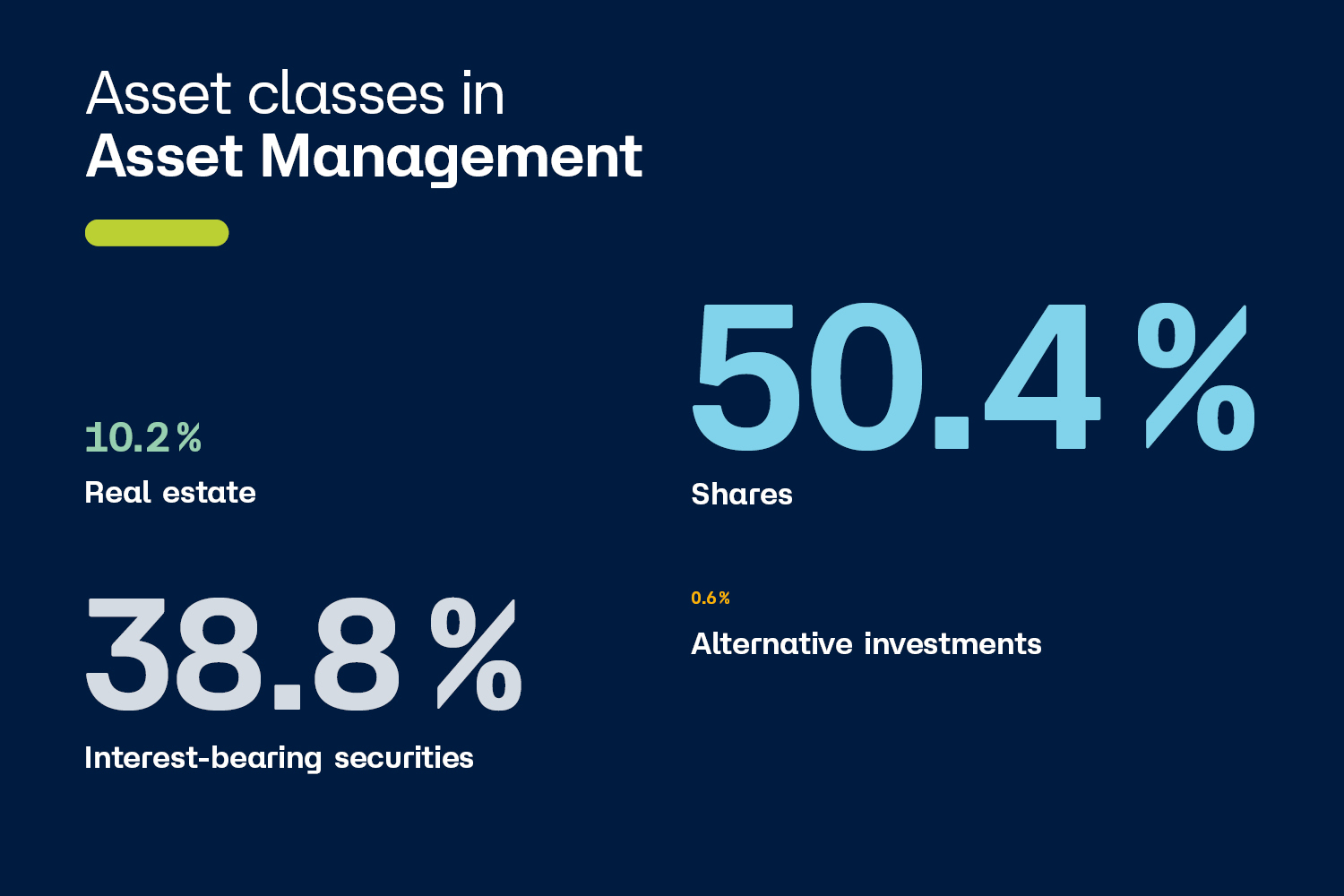
Allocation of assets in the investment portfolio to the asset classes equities, real estate and interest-bearing securities
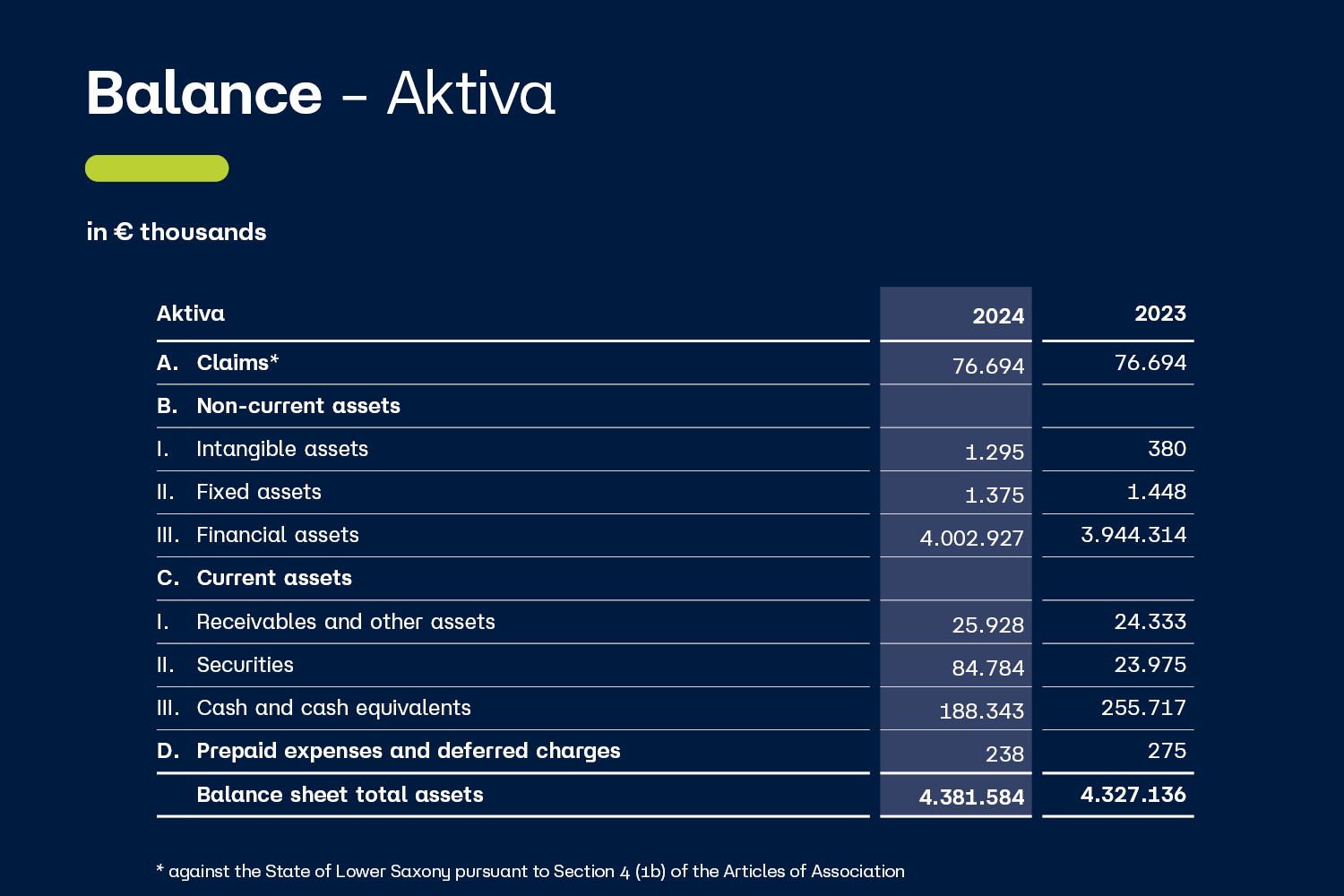
Balance - Aktiva
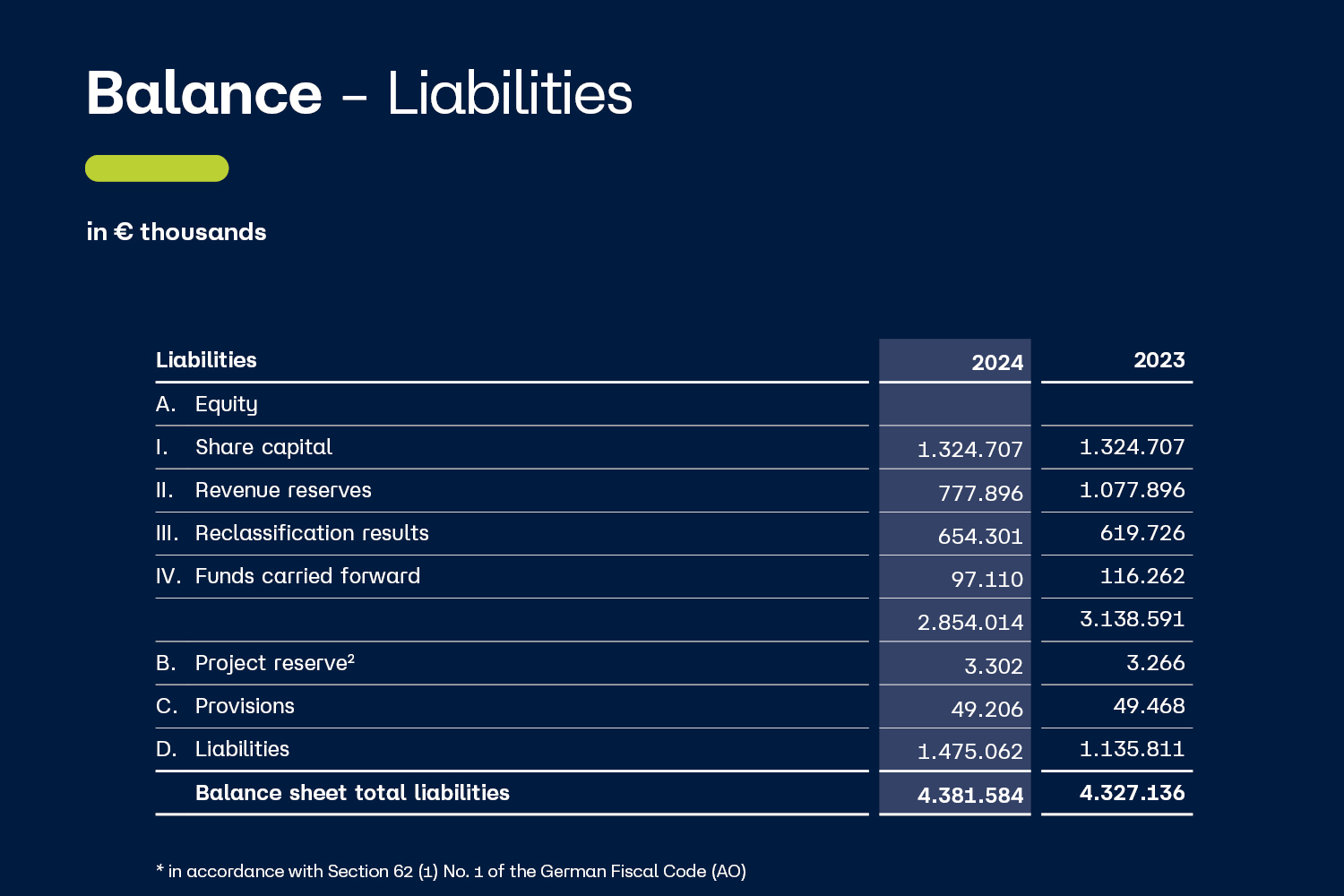
Balance - Liabilities
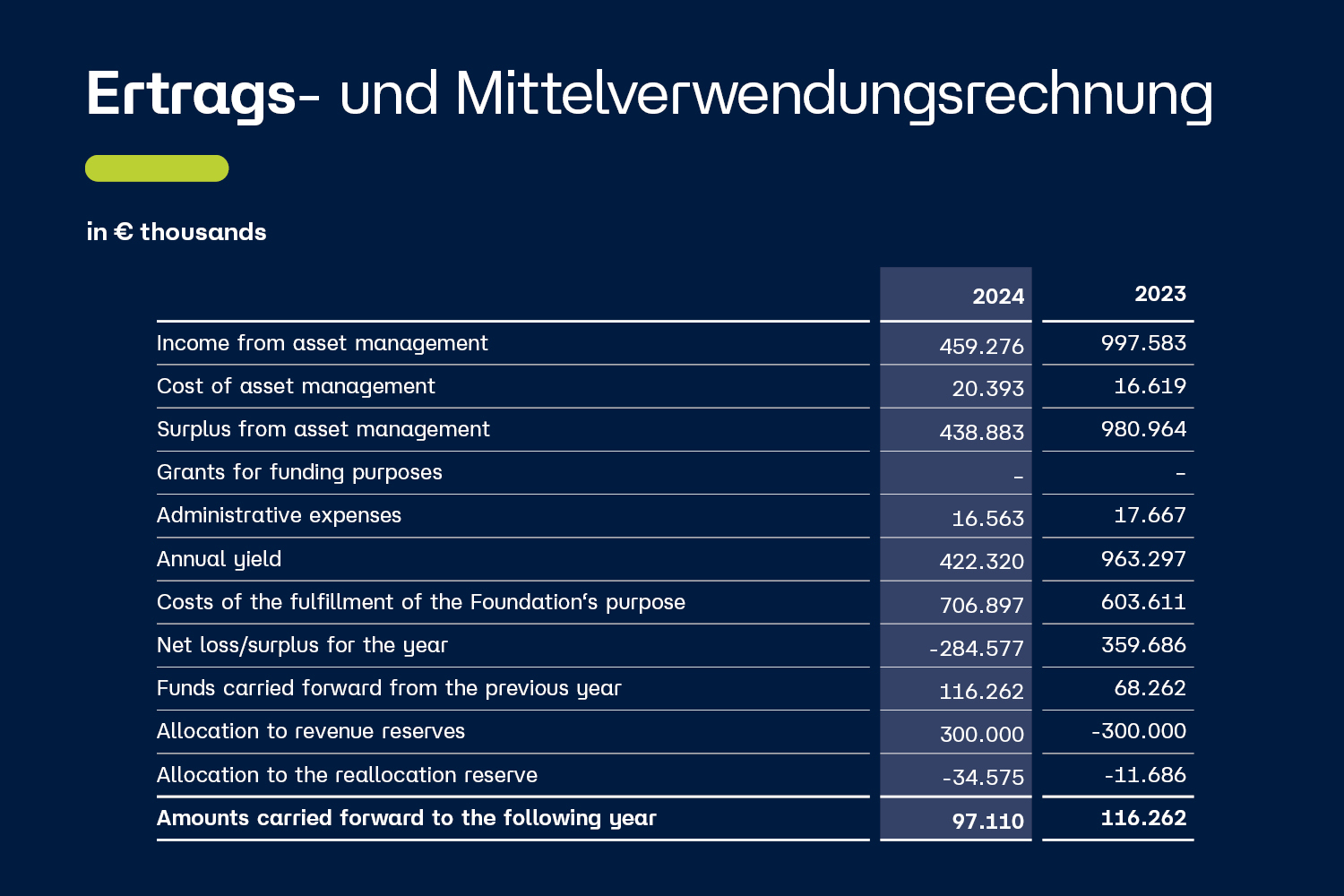
Statement of income and allocation of funds
Audit
The auditing firm BDO AG, Hanover, has audited the annual financial statements 2024 of the Volkswagen Foundation and issued an unqualified audit opinion.

Foundation
The Volkswagen Foundation is the largest private research funding organisation – and one of the largest foundations in Germany. Its purpose is to support research and teaching in the humanities, the social and natural sciences, as well as life and technical sciences. It was established more than 60 years ago by the Federal Republic of Germany and the State of Lower Saxony as an independent, non-profit foundation under civil law. The Foundation has its offices in Hanover.

Capital and Funding
The Foundation capital currently amounts to around €4.1 billion. The amount available for funding comes from the investment of this capital and is mainly used for general funding purposes. In addition, there are profit entitlements (mainly dividends) on 30.2 million Volkswagen trust shares held by the State of Lower Saxony. This funding is allocated to the zukunft.niedersachsen programme, which is jointly managed by the Foundation and the Lower Saxony Ministry of Science.

Strategy
The funding portfolio is structured around four profile areas:
- Exploration,
- Social Transformations,
- Understanding Research – Reflecting on and Practice of Science,
- zukunft.niedersachsen.
The Foundation also offers various funding opportunities in the field of science communication.

Funding Concept
The Foundation has developed four guidelines for its funding practices.
- Providing Impetus: The Foundation aims to play a pioneering role by supporting innovative pilot projects.
- Taking Risks: Creating spaces for experimentation – also for talented early career researchers.
- Crossing Borders: Transnational, interdisciplinary and transdisciplinary projects are core features of its funding.
- Shaping Structures: Funding should trigger lasting impact, a goal which the Foundation systematically analyses and pursues with a view to sharing its expertise with others.

Sustainable Investment
The Foundation’s asset management has been taking aspects of sustainability into account since 2011. The entire equity and bond portfolio is continuously monitored to ensure that ESG criteria are met. ESG defines a standard that can be used to assess an organisation’s economic sustainability. The challenge for the Foundation is to achieve the highest possible level of sustainability with its investment strategy – without jeopardising the mandate set out in its statutes, which is to invest the assets as profitably as possible.

Organisation
The Volkswagen Foundation currently employs 115 people, mainly in the three departments of funding, asset management, finance, and administration. Four staff units report directly to the CEO Dr. Georg Schütte, who heads the Foundation. The supervisory and control body is the Supervisory Board, which comprises 14 individuals from academia and other areas of society.

zukunft.niedersachsen
With a joint funding programme the Volkswagen Foundation and the state government of Lower Saxony aim at promoting research, education and transfer in Lower Saxony. The aim of zukunft.niedersachsen is to make the state significantly more visible as a centre of science in the context of domestic and international competition. The focus is on quality-assured selection processes and the ongoing identification of future-oriented fields of research. Three priority areas are currently being specifically promoted: digitality, transformation, and cutting-edge research.

History
The Foundation owes its existence and its name to an agreement between the Federal Republic of Germany and the State of Lower Saxony concluded in 1961. The Foundation was subsequently established with proceeds generated by the privatisation of the Volkswagen manufacturing company. With seat in Hanover, it started operations in 1962 as an independent, private and charitable foundation under civil law – and not as a corporate foundation.

Foundation News
New Funding Offers (2024)
- Night Science – Space for the Creative Mind Interdisciplinary tandems comprising two scientists will have the opportunity to join forces in a research context to develop unconventional ideas and hypotheses
- Open Up – New Research Spaces for the Humanities and Cultural Studies We are looking for projects that explore entirely new research spaces and topics
- The (De)tabooing of Science and Research How taboos arise in science, manage to persist, and may also be dissolved (theme week on this topic from 17 to 19 September 2025 in Hanover)
- NEXT – Quantum Biology Proving the existence of quantum effects in biological systems (one-time call for proposals; closed)
Scoping Workshops
Intensive exchange of views is at the forefront of this experimental event format. In the intensive Scoping Workshops, around 30 participants develop options for advancing their joint fields of research and creating new impact. The Scoping Workshops take place in Hanover, and the dates are set by the Foundation. The topics are chosen by the applicants.
Impact Monitoring
Over a two-year period, the funding department has developed a concept for impact monitoring tailored to its own specific needs. The Fraunhofer Institute for Systems and Innovation Research (ISI) is the Foundation’s partner in this process. The objectives are to enhance support for strategic decision-making through providing more empirical evidence and enabling structured tracking to verify whether funding offers are achieving their defined goals.

Reform of the Statutes
A revised form of the Foundation's statutes has been in effect since March 2025. This was prompted by recommendations resulting from an overall evaluation of the Foundation, an audit carried out by the Federal Audit Office, and the reform of foundation law. One of the changes is that the former Board of Trustees will now act as a supervisory and control body, a Supervisory Board, while a new CEO is now anchored in the statutes and will be responsible for the management. This function is taken on by the former Secretary General, Dr Georg Schütte. From 1 January 2028, the statutes provide for an Management Board consisting of at least two persons.

Administration of Funding
At the turn of the year 2024/25, the Foundation launched its new digital system in the area of Funding Administration. The transition from the old to the new system took a great deal of time and effort, so it is all the more gratifying to know that we now have a tool that makes many things much easier for both employees and applicants, such as the electronic submission of applications, project outlines and cost projection. In the future, funding requests and expenditure reports will also be handled via the funding portal.

status 2023 – Annual report of the Volkswagen Foundation

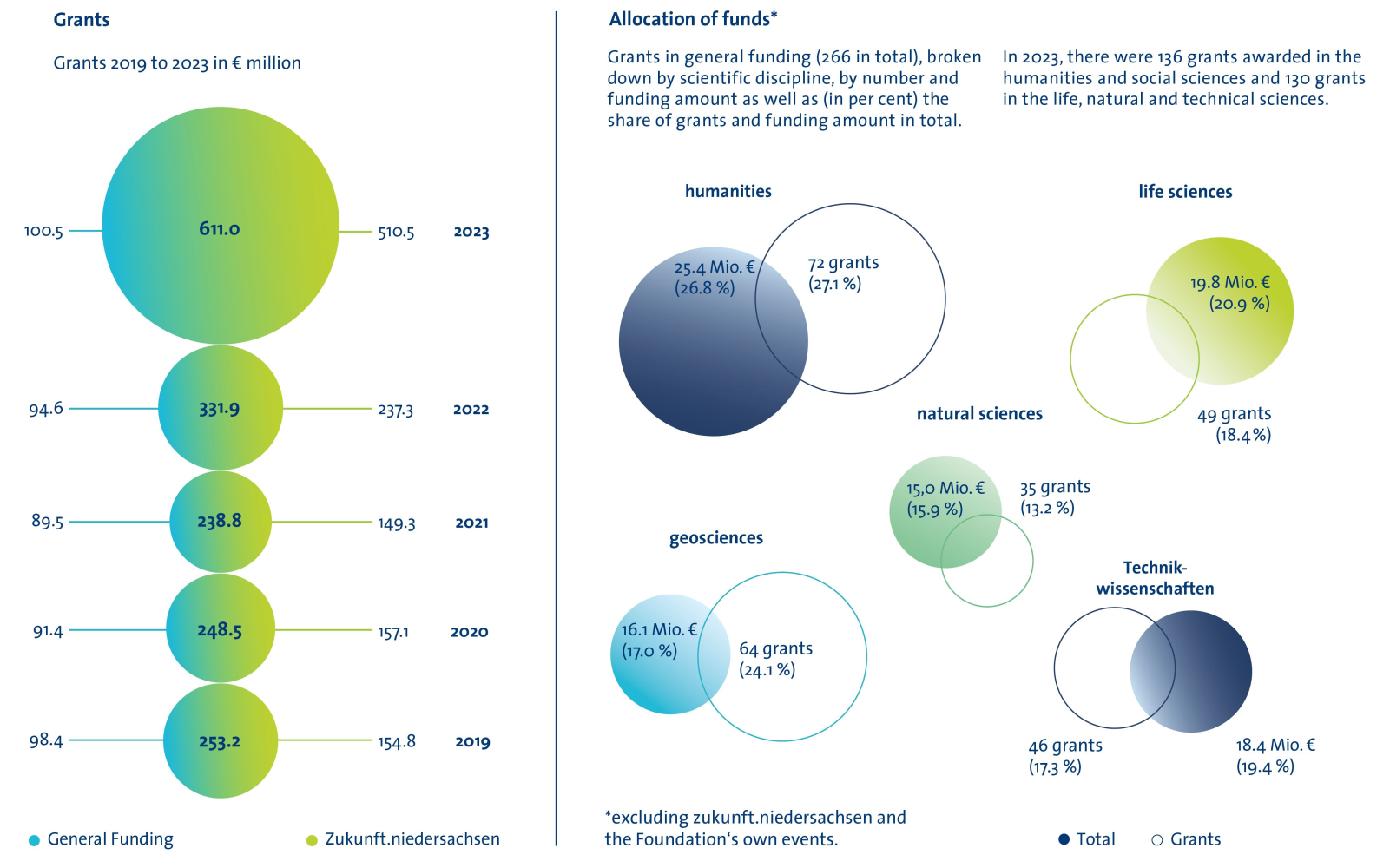
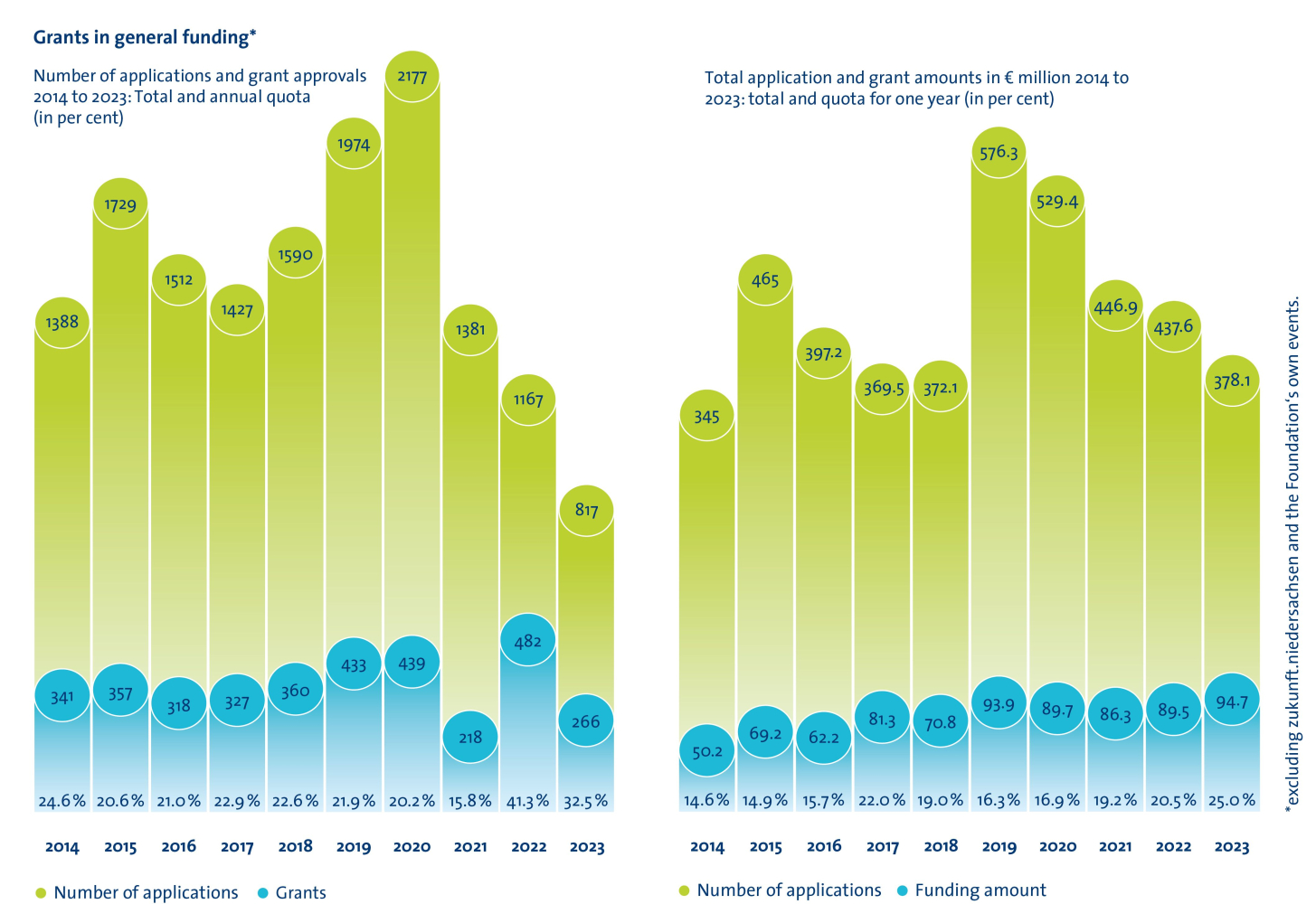
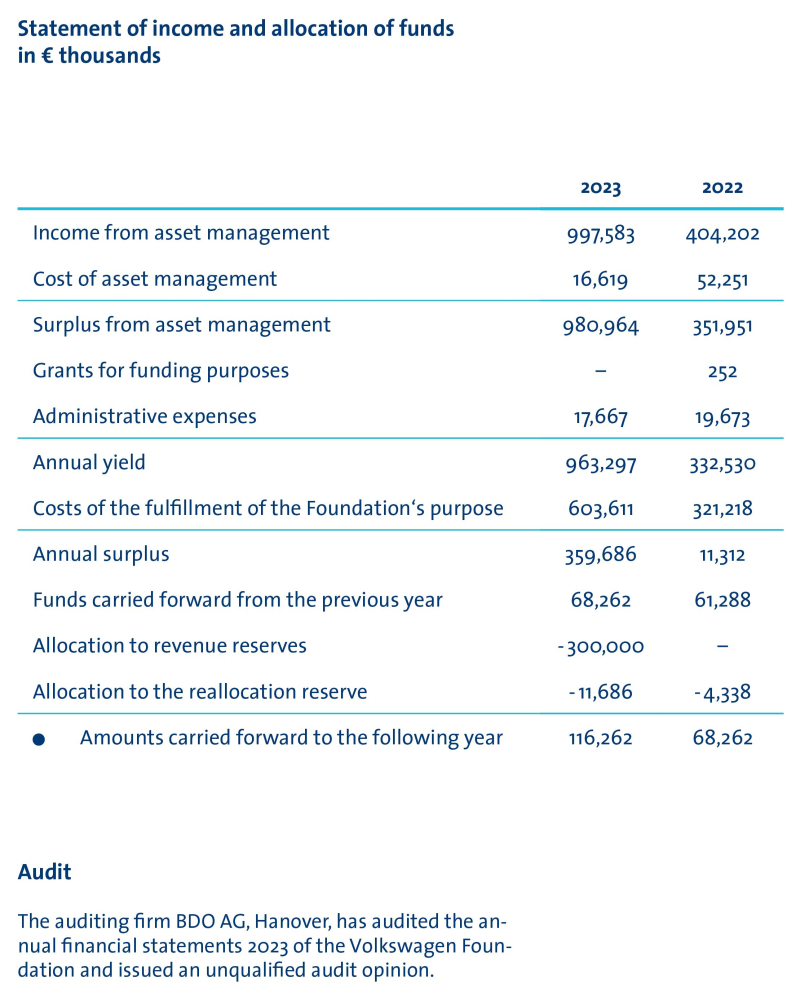
In 2023, the Volkswagen Foundation approved more than EUR 600 million for scientific projects. Figures, data and facts from our 2023 annual report.
At a glance: The most important figures, data and facts

The foundation
The Volkswagen Foundation is probably the largest private research funding organisation and one of the largest foundations in Germany. Its purpose is to support the humanities, social sciences and natural, life and technical sciences in research and higher education. It was founded by the Federal Republic of Germany and the State of Lower Saxony more than 60 years ago as an independent charitable foundation under private law. Its headquarters are in Hannover.

Capital and funding
At present, the Foundation’s capital amounts to approx. 4.1 billion euro. The resources available for funding are generated from asset investment and allocated mainly in the area of "General Funding". Added to this are profit entitlements from 30.2 m Volkswagen trust shares held by the Federal State of Lower Saxony (mainly dividends). These funds are awarded to research in the programme zukunft.niedersachsen, which is jointly managed by the foundation and the Lower Saxony Ministry of Science. In 2023, the foundation received a one-off payment of 576.3 million euro from a special dividend of Porsche AG. This amount will be approved in the medium term in the programme zukunft.niedersachsen.

Strategy
Four profile areas structure the funding portfolio:
- Exploration,
- Societal transformations,
- Understanding Research – Evaluation and Science Practice,
- zukunft.niedersachen.
There is also a focus on the cross-sectional area Science in Society.

Funding concept
The Foundation has developed four guidelines for its funding practices.
- Providing impetus: The Foundation aims to play a pioneering role by supporting highly innovative pilot projects.
- Taking risks: It creates experimental spaces for upcoming top researchers.
- Crossing borders: Transnational, inter- and transdisciplinary projects characterize its funding activities.
- Shaping structures: The Foundation aims at generating sustainable effects. These are systematically analysed in order to benefit from lessons learned and subsequently shared with others.

Investing sustainably
In the area of asset management, the Foundation began taking sustainability aspects into account as early as 2011. Since then, the entire equity and bond portfolio is the subject of continuous analysis to determine whether ESG criteria are met. ESG defines a standard that can be used to check how sustainably a company is positioned. The challenge for the Foundation is to shape its investment strategy so it achieves the highest possible level of sustainability without jeopardizing the mandate set out in the statutes, which is to invest its assets as profitably as possible.

Organization
The Volkswagen Foundation currently employs around 110 people, mainly in the three departments of Funding, Investment, Finance and Administration. Four staff units report directly to the Secretary General, Dr. Georg Schütte, who heads the Foundation. The Board of Trustees is made up of 14 personalities from the scientific community and other areas of civil society. The Board of Trustees usually meets three times a year to decide on strategy issues and funding applications.

zukunft.niedersachsen
The Foundation and the government of the State of Lower Saxony recently joined forces to create their own funding programme to boost research and education in Lower Saxony. The aim of zukunft.niedersachsen is to make Lower Saxony a much more visible science location in national and international competition. The focus is on quality-assured selection procedures and the ongoing identification of cutting-edge fields of research. Three key areas are currently being specifically promoted: Digitality, transformation, and research excellence.

History
The Foundation owes its existence and its name to an agreement concluded between the Federal Republic of Germany and the state of Lower Saxony in 1961. The then ‘Volkswagenwerk GmbH’ was converted into a stock corporation, thus settling the dispute over the unresolved ownership relationships. The proceeds from this privatization were used to establish the Foundation, which began its work in Hanover in 1962 as an independent, private, and public benefit foundation under civil law – and not as a corporate foundation.
Picture gallery: Figures and graphics


News from the Foundation
Funding opportunities
In the three areas of general funding (‘Knowledge about Knowledge’, ‘Societal Transformations’, ‘Exploration’), these calls for proposals were launched in 2023:
- Transdisciplinary Approaches to Mobility and Global Health
Exploring the interactions of mobility and health - Circularity in everyday life - Ideas competition
Making the raw materials transition tangible for a broad audience - Change! Fellowships and Research Groups
Researching and initiating transformation processes - Earth System Sciences
Establishing junior professorships for a new systems science - Circularity with recycled and biogenic raw materials - Cooperation projects
Closing the raw material-product cycle with sustainable concepts - Transformation of democracy – Task forces/cooperation projects
Opening up new perspectives on the transformation of democracies - Theme weeks: Scientific ethics, human rights
See all current funding offers at "Our funding portfolio"
zukunft.niedersachsen
Thanks to a special dividend from Porsche AG, the Volkswagen Foundation was able to grant a record sum for the promotion of science and education in Lower Saxony in 2023. In the joint program zukunft.niedersachsen created by the Foundation and the government of the state of Lower Saxony, 'Strategic development of potential' is the financially strongest funding program to date. 265 million euros are available for proposals from universities in Lower Saxony that want to design and implement long-term development strategies. More information and all funding opportunities can be found on the new website: zukunft.niedersachsen.de.
Sustainability
With the goal of climate neutrality, the Foundation is constantly striving to improve its carbon footprint and align its business operations with aspects of sustainability. A new milestone has now been reached on this path: using data from 2023, the first report has been produced in accordance with the formal criteria of the German Sustainability Index. It provides a sound basis on which the foundation will develop new measures to make its impact as climate-neutral as possible. More information about sustainability in the activities of the VolkswagenStiftung at sustainability.
Keyword: Academic freedom
The Volkswagen Foundation is concerned about the growing pressure to which researchers in Germany and abroad are exposed. And is resisting this development not only with words, but also with deeds. For example, in 2022, following Russia's invasion of Ukraine, it created a million-euro funding program for scientists who had fled the country in just one week - as it had previously done in the case of Turkey and Afghanistan. Following the terrorist attack by Hamas, the Foundation and the state of Lower Saxony increased the budget for the 'Research Cooperation Lower Saxony - Israel' program as a sign of their solidarity with researchers in Israel. In addition, the 'Social Transformation' focus area bundles funding projects that the foundation hopes will provide validated impetus on how to counter the radicalization of subpublics. The Foundation is convinced that free science needs an open society.


Strategic guidelines: Transdisciplinarity - transfer - science communication
The Volkswagen Foundation's strategic guidelines on transdisciplinarity.


status 2022 – Annual report of the Volkswagen Foundation
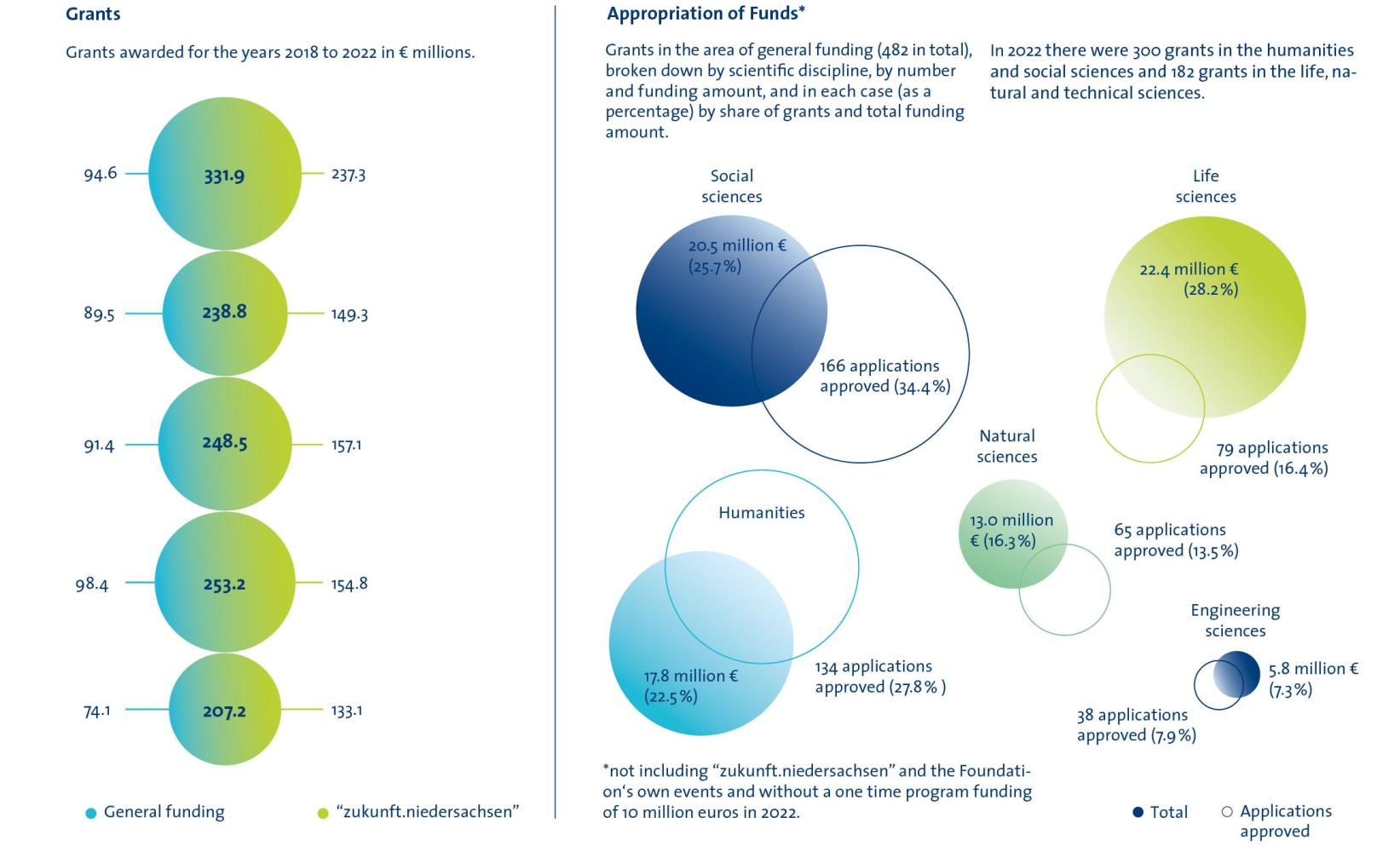
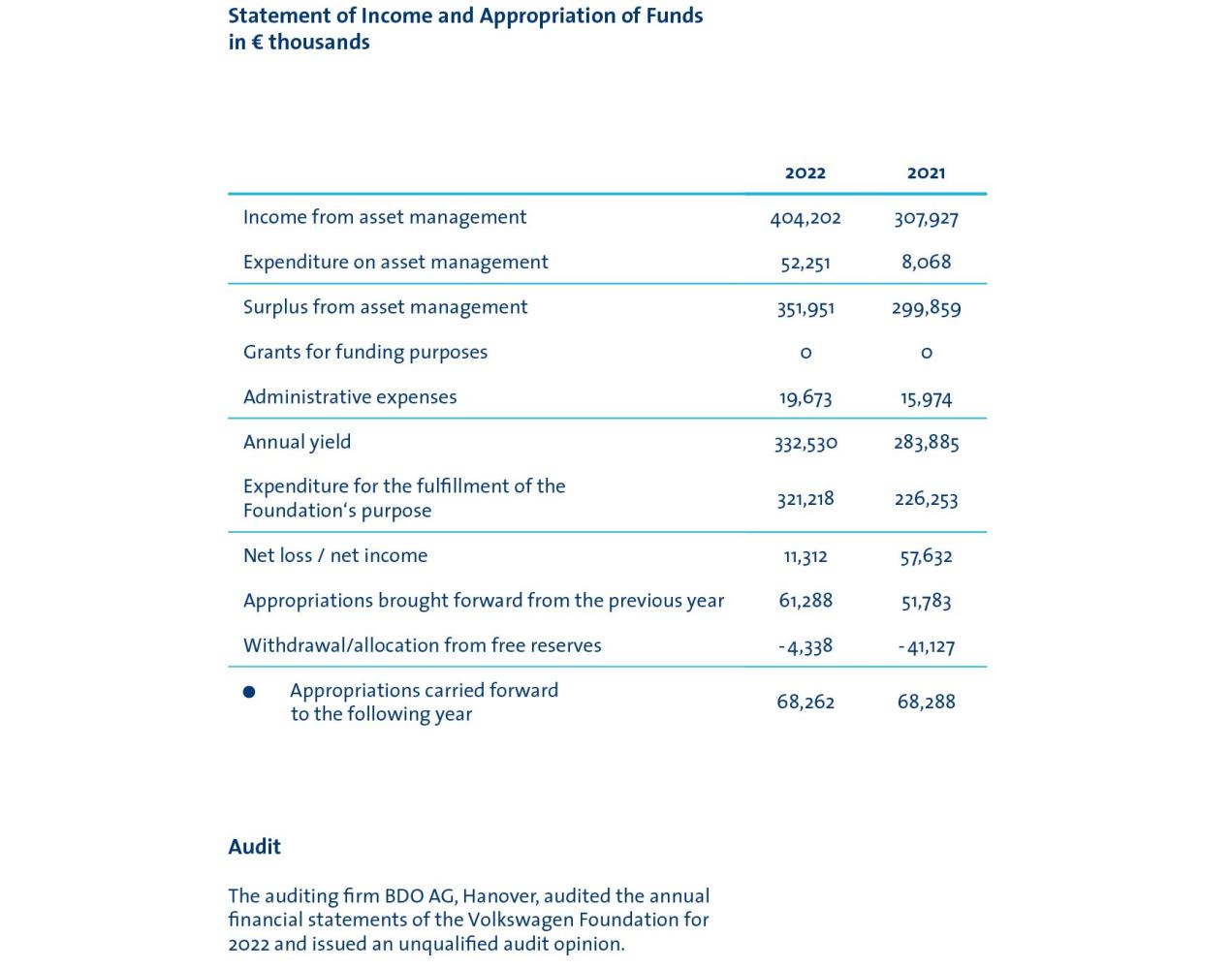
In 2022, the Volkswagen Foundation approved EUR 331,9 million for scientific projects. Figures, data and facts from our 2022 annual report.
At a glance: The most important figures, data and facts
The Foundation
The Volkswagen Foundation is the largest private research funding organization and one of the largest foundations in Germany in terms of foundation capital. Its purpose is to support the humanities, social sciences and natural, life and technical sciences in research and higher education. It was founded by the Federal Republic of Germany and the State of Lower Saxony as an independent charitable foundation under private law. The Volkswagen Foundation, which is based in Hanover, is not affiliated to the Volkswagen automobile manufacturer.

Capital and funding
At present, the Foundation's capital amounts to approx. 3.4 bn. euros. The resources available for funding are generated from asset investment and allocated mainly in the area of 'General Funding'. Added to this are profit entitlements from 30.2 m. Volkswagen trust shares held by the Federal State of Lower Saxony (mainly dividends). These funds are awarded to research institutions in Lower Saxony, in close cooperation with the state government (see 'zukunft.niedersachsen'). In 2022 the funding volume in this area amounted to 237.3 m euros. Since the Foundation started its activities in 1962 funding totalling 280 bn. euros was approved.

Strategy
Three profile areas structure the funding portfolio: 1. Exploration, 2. Societal transformations, 3. Understanding Research – Evaluation and Science Practice. There is also a focus on the cross-sectional area Science in Society.
Funding concept
The Foundation has developed four guidelines for its funding practices.
- Providing impetus: The Foundation aims to play a pioneering role by supporting highly innovative pilot projects.
- Taking risks: It creates experimental spaces for upcoming top researchers.
- Crossing borders: Transnational, inter- and transdisciplinary projects characterize its funding activities.
- Shaping structures: The Foundation aims at generating sustainable effects. These are systematically analyzed in order to benefit from lessons learned and subsequently shared with others.
Investing in sustainability
The Foundation’s investment policy has been taking sustainability aspects into account since 2011. The entire equities and bonds portfolio is analyzed on an ongoing basis to determine whether ESG criteria are being observed, i.e., whether investments are, among other things, purposefully geared towards considerations of sustainability. The challenge for the Foundation with its investment strategy is to achieve the highest possible degree of sustainability – without jeopardizing the mission set out in the Articles of Association to invest its assets as profitably as possible.
Organization
Currently, the Volkswagen Foundation employs about 100 people, mainly in the three departments of Funding, Investment, Finance and Administration. Four staff units report directly to the Secretary General Dr. Georg Schütte, who heads the Foundation. The Board of Trustees comprises 14 personalities belonging to the scientific community and other areas of society. It usually meets three times a year to decide on strategy issues and funding applications.
zukunft.niedersachsen
The Foundation and the state government jointly support research and higher education in Lower Saxony with a specific funding program. The goal of zukunft. niedersachsen is to make the science location tangibly more visible in national and international competition. The focus is on quality-assured selection processes and the ongoing identification of cutting-edge research fields. Currently, three focal points are being specifically promoted: Digitality, Transformation and Research Excellence. zukunft.niedersachsen replaces the predecessor program 'Niedersächsisches Vorab' as of 2023.
History
The Foundation owes its existence and its name to an agreement between the Federal Republic of Germany and the state of Lower Saxony concluded in 1961: the 'Volkswagenwerk GmbH' was converted into a stock corporation, thus settling the dispute over the unresolved ownership situation. The proceeds from this privatization were used to establish the Foundation, which began its work in Hanover in 1962. It is an independent private, non-profit foundation under private law – and not a corporate foundation.
Picture Gallery: Numbers and Figures