Climate Research Using Old Ship’s Logs: the Wind Leaves no Trace on the Sea
#Basic Research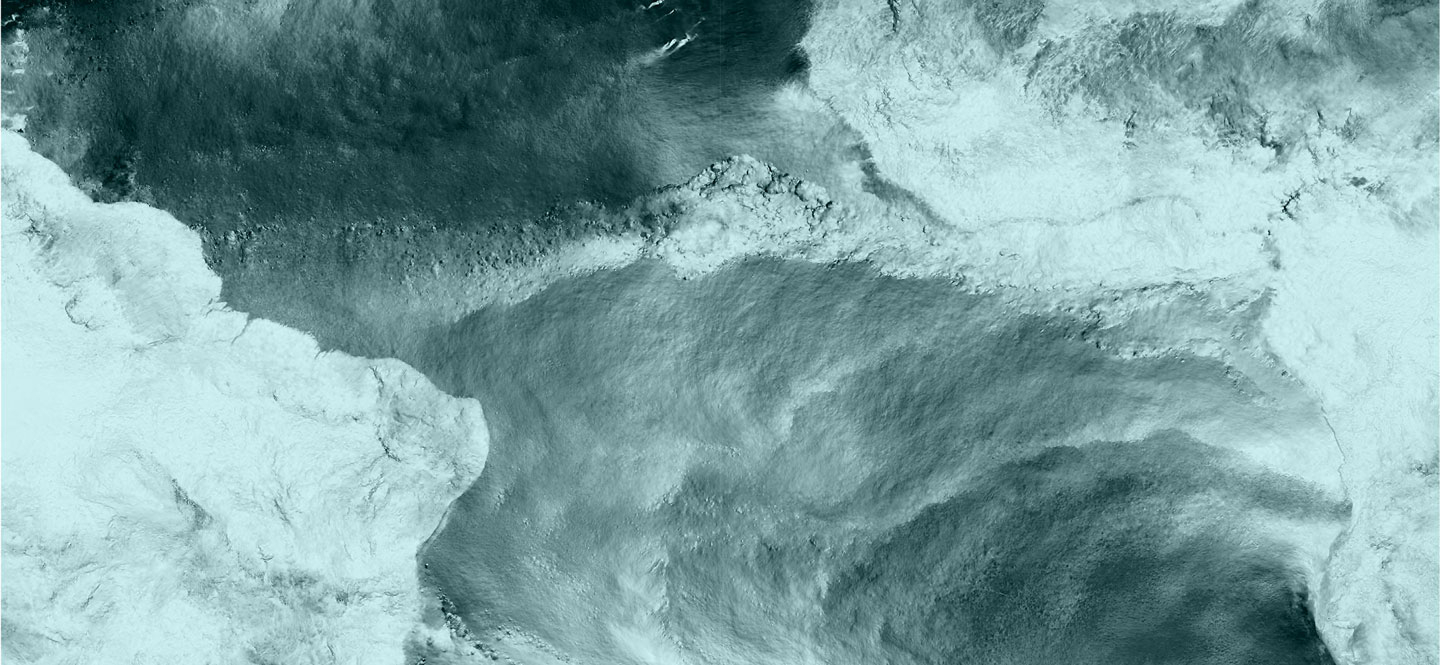
Max-Planck-Institut für Meteorologie | Grafik und Datengrundlage
The Doldrums, the windless zones of the Intertropical Convergence Zone (ITCZ) feared by sailors, are to be reconstructed using historical ship’s logs – thereby providing data for climate research.
Did a volcanic eruption in 1783 shift the tropical rain belt? Old ship’s logs could provide the answer – and also shed light on the future climate for millions of people living around the equator.
What does a period of calm winds along the west coast of Africa in 1783 tell us about how today’s climate change will alter living conditions for millions of people in the tropics? Quite a lot, according to Dr Claudia Timmreck, Dr Julia Windmiller and Prof. Dr Eleonora Rohland.
The three researchers are united by an unusual idea: they aim to use historical ship’s logs to determine how the so-called Intertropical Convergence Zone (ITCZ) – commonly known as the tropical rain belt – changes as the global average temperature shifts. The Volkswagen Foundation is funding the project for four years as part of the Pioneering Research – Exploring of the Unknown Unknown.
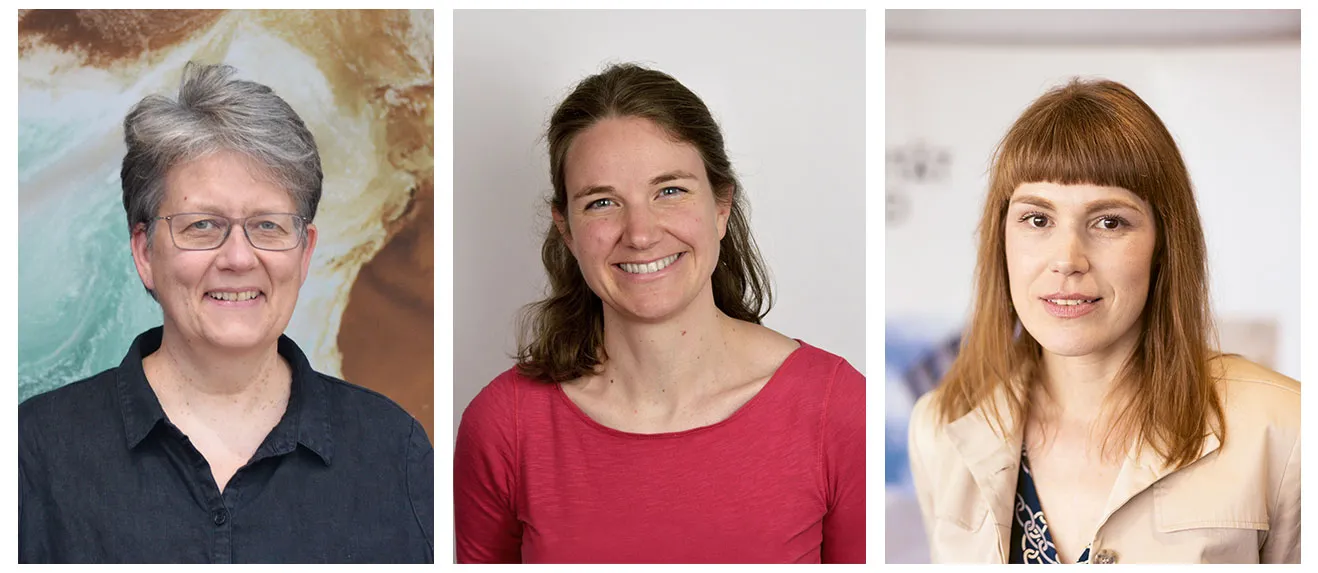
The two atmospheric physicists Claudia Timmreck and Julia Windmiller, along with climate historian Eleonora Rohland (from left), are jointly coordinating the DOLDRUMS project across continents: from Bielefeld, Hamburg and Melbourne.
We can only model the future if we have data from the past.
Windmiller, who now conducts research and teaches at Monash University in Australia, has herself led measurement campaigns in the tropical Atlantic and knows the ITCZ intimately. But the zone is also clearly visible on a global precipitation map: it forms a band a few hundred kilometres wide near the equator, where a third of the Earth’s total rainfall occurs. Hundreds of millions of people live there. "If this band were to shift by just one degree, entire agricultural regions would suddenly be without rainfall," says the researcher. “That would mean food insecurity for millions of people." What’s more, if the ITCZ shifts, it affects the global circulation of the atmosphere. That would also have an impact on the weather in Europe.
A combination of calm spells and violent thunderstorms
Over the Atlantic, the rain belt is characterised above all by large areas of calm interspersed with heavy rainfall. As early as the late 17th century, the astronomer and meteorologist Edmund Halley described the equatorial region off the coast of Africa as an area of calms and violent thunderstorms. The term ‘doldrums’ was later coined to describe these zones, and it is this term that gives the current research project its name.
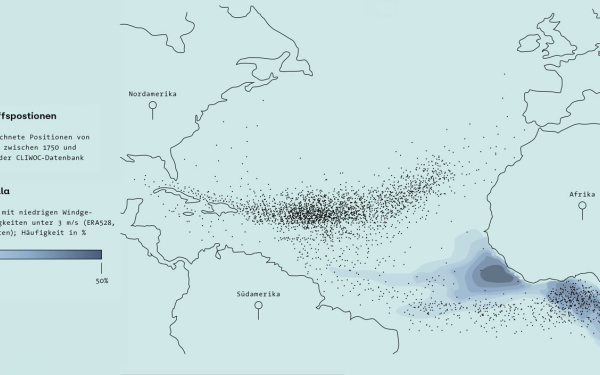
During the age of sailing ships, the Doldrums were dangerous areas. With no wind, ships would frequently become stranded for hours or days, and their journey across the Atlantic was sometimes extended by weeks. "People starved and died of thirst because their supplies ran out," explains climate historian Rohland, who works at Bielefeld University. Mutinies and slave uprisings were not uncommon. Experienced captains therefore adjusted their course accordingly or were able to read the weather well enough to avoid the Doldrums. Others, however, were less fortunate and also less skilled at avoiding these dangerous, windless regions. In any case, the logbooks of the time recorded, as part of daily measurements, when and where in the tropical Atlantic there was a windless period.
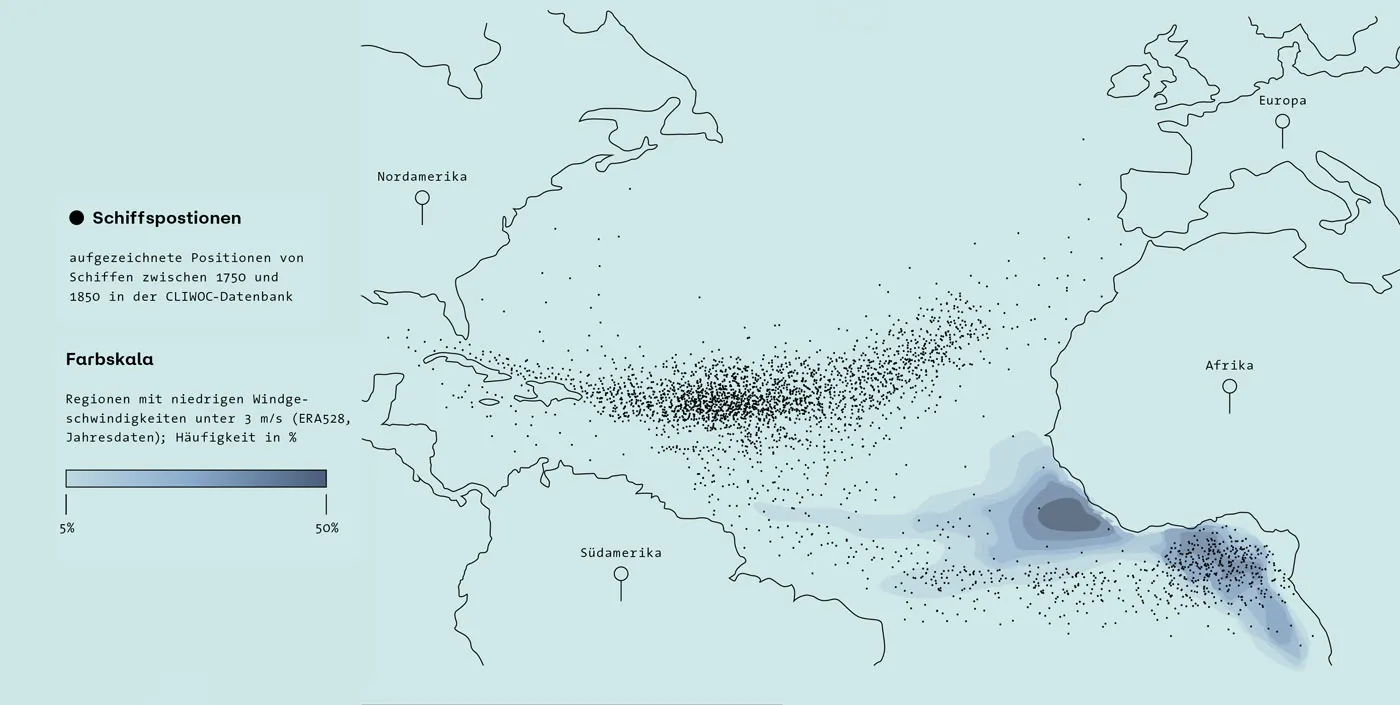
Ship positions (1750–1850) from the CLIWOC database (black dots) and regions with wind speeds below 3 m/s in the ERA5-reanalysis-data (light blue to dark blue)
36,000 slave ships across the Atlantic
But what ships actually sailed through the tropics back then? "We came across the Atlantic triangular trade, in which enslaved people were transported from Africa to the Caribbean," explains Timmreck, an atmospheric physicist at the Max Planck Institute for Meteorology – adding: "It is shocking how many voyages took place and how many people were shipped across the ocean."
Around 36,000 transatlantic voyages are documented in the Slave Voyages database. The relevant logbooks contain detailed information on wind conditions and rainfall.
As it would be impossible to analyse all this data within the scope of the project, the researchers are focusing on a few years from 1783 onwards. In that year, the Icelandic volcano Laki erupted over a period of several months, and its aerosols caused a short-term cooling of the northern hemisphere. "Global warming is progressing gradually," says Timmreck, "but a major volcanic eruption represents a massive short-term disruption to the climate system – changes can be observed relatively quickly." There is much to be learnt from this. If the models and hypotheses are correct, the Laki eruption must have temporarily shifted the ITCZ southwards. The evidence for this could be hidden in the ship’s logs.
What is the wind speed of a "light breeze"?
But how does one analyse logbooks with scientific precision? Although a relatively standardised vocabulary for describing winds at sea had already become established by 1783, the Beaufort scale as a standard measure of wind force was not invented until 1806 and was not made compulsory in British shipping until 1838. "So what exactly did ‘light breeze’ or ‘soft gale’ mean before that time?" asks Rohland. Twenty years ago, an EU-funded project analysed almost 300,000 logbooks to support climate research and convert weather descriptions into digital data. Using modern methods – including machine learning – Rohland and her colleagues aim, on the one hand, to classify this existing data relating to the ITCZ even more precisely. On the other hand, they will also be collecting historical data from ship’s logbooks from scratch themselves.
We get to experience the weather from 200 years ago. It’s incredibly interesting!
These documents are particularly valuable for historical climate research: whilst natural climate archives such as cave minerals and sedimentary deposits provide, at best, a seasonal timescale, logbooks offer daily information about the weather. "If you look at the records of a ship’s route, you can clearly see: it rained on this day, then the winds shifted and there was a period of light winds," says Windmiller. "We experience the weather from 200 years ago. That’s incredibly interesting!" Because there are still many unanswered questions about the influence of the weather and changes in the weather on the climate and climate change in the tropics.
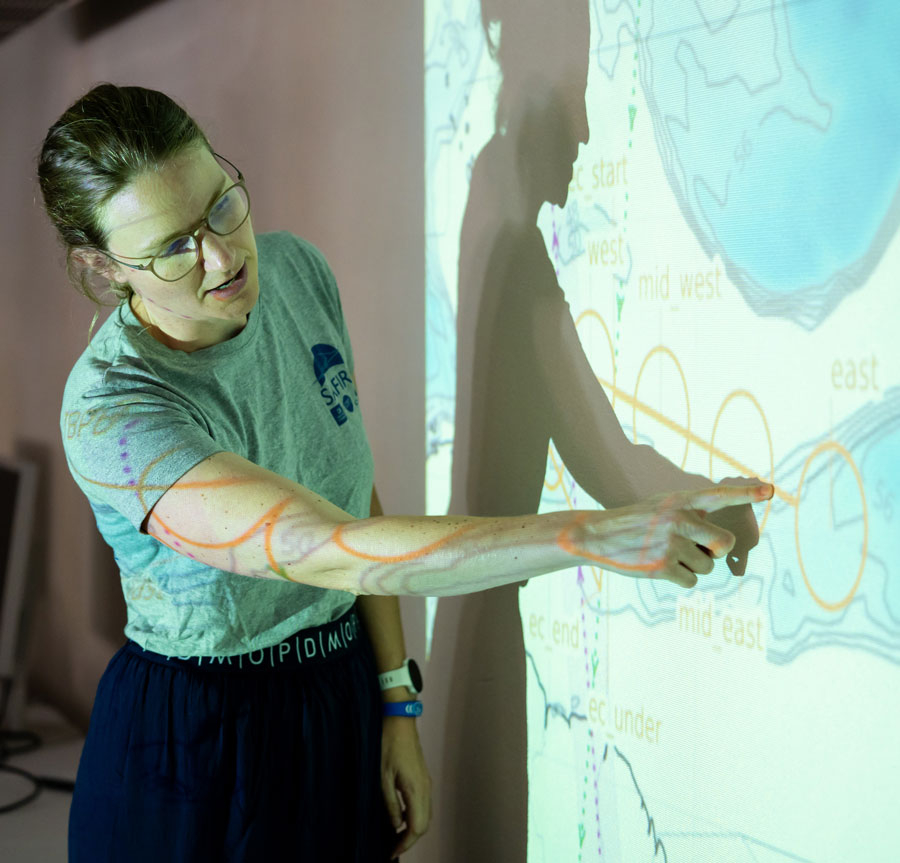
Julia Windmiller studies tropical clouds, whose changes play a significant role in the global climate system.
How is climate change affecting the rain belt?
In addition, the researchers intend to use high-resolution simulations based on climate and weather models to run virtual ships under different years and wind conditions. By comparing these with the logbooks, it will be possible to determine how well the models perform under changing climatic conditions. "Our aim is to see how the ITCZ behaves under more extreme climatic conditions," explains Rohland. This would make it possible to predict how the rainband will change as a result of global warming. That could enable people in the affected regions to adapt more effectively. "But we can only model the future if we have data from the past," emphasises the climate historian. It is considered certain that the ITCZ always shifts towards the warmer hemisphere. But as for how wide the band is and how severe the weather phenomena will be, the data is still very uncertain.
"We want to gain a better understanding of how our planet’s global circulation works," explains atmospheric physicist Windmiller. This is fascinating, she says, because it is such a central element of the climate system. "For climate research, this is very fundamental – and yet directly relevant." Timmreck, who has always been interested in understanding the past in order to perhaps understand what will happen in the future, adds: "Basic research is also a form of risk insurance. We are investing in possibilities that we can draw on later."
Basic research is not some intellectual game of 'glass beads' played in a fantasy world, but the very foundation of a society’s survival in the face of climate change.
Basic research is knowledge for the future
"Conducting basic research is absolutely vital, even if we don’t always see a direct application," agrees historian Rohland. In the project, she is also interested in how, for example, slave uprisings on ships are linked to being stuck in the doldrums, or what knowledge about the doldrums was conveyed in historical sailing manuals. "Even if something in historical research doesn’t always seem directly relevant to the present, it’s still important that we know these things," says Rohland. Perhaps the knowledge will be needed again in a specific context. "But when it comes to disasters and climate research, history is almost always relevant to the present," the researcher knows from experience.
"None of us could do this work on our own," the three researchers agree, raving about the diverse opportunities, but also the challenges, that interdisciplinary collaboration offers. It is great that there are funders such as the Volkswagen Foundation who support such interdisciplinary and experimental projects. This is particularly true at a time when funding programmes are being thematically reoriented and narrowed down by politically motivated decisions, and basic research increasingly has to justify itself. "We don’t know whether our idea will ultimately be successful," conclude Timmreck, Windmiller and Rohland. "But we very much hope that we will achieve our goal and will certainly gain a great deal of new insight along the way."