ehrenwerk.tv für VolkswagenStiftung
Hybrid Computers Made of Nerves and Fibre Optics
Wolfram Pernice is researching how computers based on neural networks could in future compute even faster and more efficiently – using light instead of electronics. And real nerves instead of optical fibres.
A long-cherished dream in medical technology is to control prostheses using only the power of thought – as is common in science fiction films –. A bionic arm, for example, surgically fitted after an accident, should feel like a natural part of one’s own body. And function just as well as the old arm. Or even better. Star Wars hero Luke Skywalker sends his regards.
Initial attempts at this already exist, but signal translation is still often problematic and movements remain limited. It is very difficult to replicate the complex natural exchange of information between the brain and muscles on a one-to-one basis. The crucial component for this is the so-called brain-computer interface – a microchip connected to the nervous system. It translates brain impulses into electronic control signals for the prosthesis and, conversely, the prosthesis’s tactile signals into sensations.
Out of the box
Wolfram Pernice, Professor of Experimental Physics at Heidelberg University, is working on such chips, which could be used not only in medicine but also in computer technology more generally.
ehrenwerk.tv für VolkswagenStiftung
Wolfram Pernice in a video portrait: Brain meets chip – hybrid systems for AI’s energy demands (English subtitles available)
Pernice's approach is entirely new, which is why the Volkswagen Foundation is supporting him through its Momentum funding initiative: this supports researchers in projects that show great promise but take an unconventional approach. They are venturing into uncharted scientific territory with an uncertain outcome – and therefore receive less attention from other funding organisations.
In basic research, it’s actually the norm that nothing works as intended at first.
That, says Pernice, is precisely what makes basic research and a programme like Momentum so exciting: "Here, I am allowed and able to really think ‘outside the box’ and try out outlandish ideas." In fact, he adds, it is usually the case that nothing works at first. "But if you stick with it, you sometimes find a completely new solution to an important problem."
The researcher, who was born in Riedlingen an der Donau, attributes his enthusiasm for technology to his excellent physics teachers. And also to the inspiration provided by science fiction: it anticipates many developments that modern technology – be it robotics, nanotechnology or biotechnology – is bringing within the realm of possibility.
Pernice’s work is so successful that in 2025 he received the Gottfried Wilhelm Leibniz-Prize, the most prestigious scientific award in Germany. At the award ceremony, Katja Becker, President of the German Research Foundation, praised Pernice for demonstrating "how short the path from basic research to application can be."
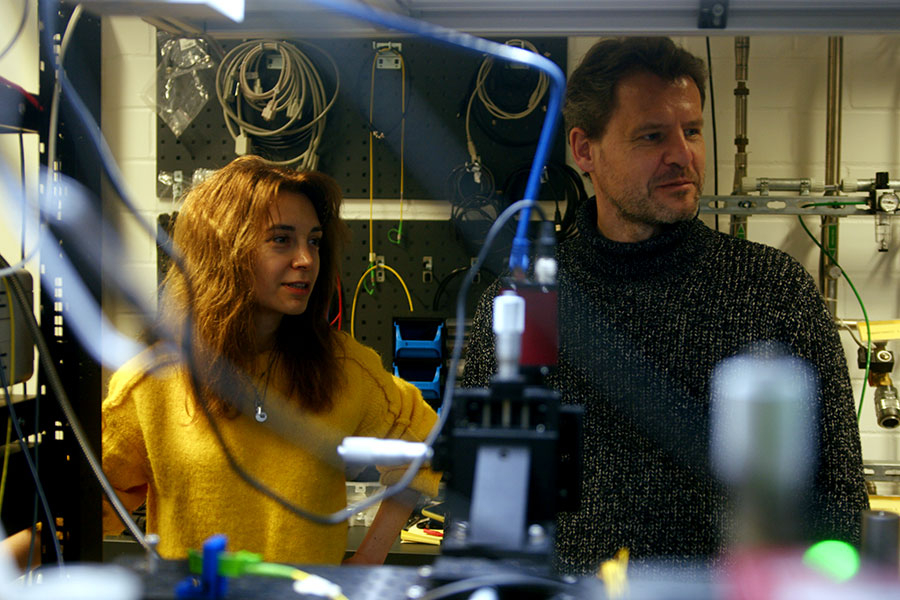
Pernice’s "Neuromorphic Quantum Photonics" research group comprises around 60 researchers, including postdoctoral researcher Dr Anna Ovvyan (left).
Light instead of electrons
The physicist is researching microchips modelled on the brain’s neural networks, but which use optical signals instead of electrical ones. Fibre optics instead of copper cables, so to speak. As with the internet, this would also offer various advantages for brain-computer interfaces: "Fibre optics," says Pernice, "can transmit data much faster; the material is inexpensive, flexible, easy to install, durable and – which is particularly important for implants – biocompatible."
Together with researchers at the University of Oxford in England, where Pernice once completed his PhD, his team developed a thumbnail-sized microchip years ago that simulates four neurons and 60 synapses. Such chips are known as ‘neuromorphic photonic systems’. The light circulates within a special waveguide geometry made of semiconductor materials such as silicon nitride or silicon. These function like optical fibre, but allow for even smaller structures on the chip. In this way, the light triggers switching processes in phase-change materials, similar to those on DVDs: they switch between transparent and opaque using a laser.
In this way, the optical chip succeeded in storing data and performing simple arithmetic operations. "If we develop this principle further, it may one day be possible to use optical circuit boards in computers instead of conventional graphics cards," says Pernice. They would be faster and more energy-efficient, as they transmit data at the speed of light and without electrical resistance. They also generate hardly any heat that needs to be dissipated. Several start-ups worldwide – including one in Oxford, which Pernice co-founded – are working on this.
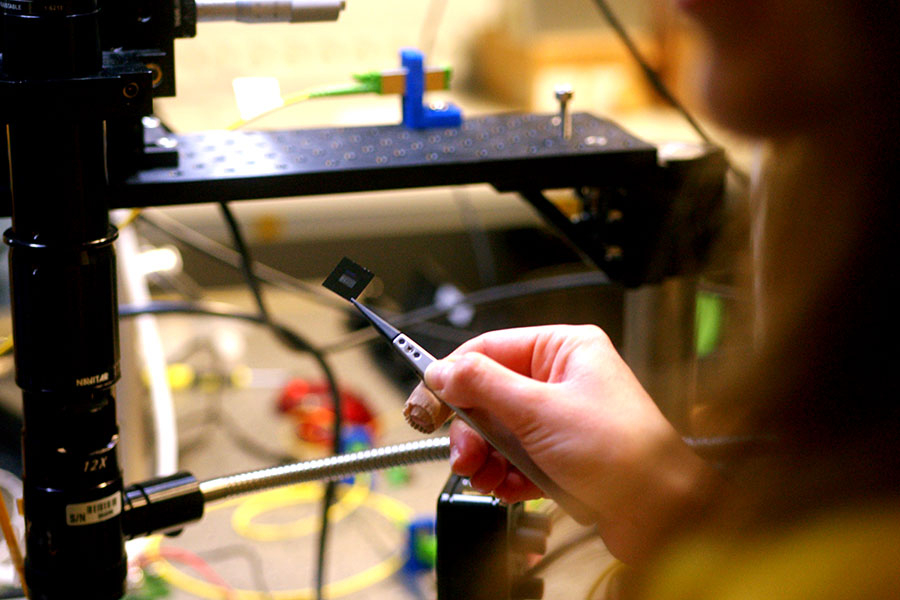
No bigger than a thumbnail: Pernice’s chip is a neuromorphic photonic system that simulates four neurons and 60 synapses.
Progress in this field is urgently needed. This is because digitalisation and the AI boom are driving up our electricity demand. Data centres already consume 1.5 per cent of global electricity generation and, according to estimates, will double their demand by 2030. "Without greater energy efficiency, we will reach the limits of our capacity expansion, particularly due to the rapid spread of artificial intelligence," warns Pernice. Optical chips could help here: initial laboratory tests show power consumption per computational operation that is ten to a thousand times lower.
Computing with real nerve cells
But that is not yet enough for the interaction between brain and machine. An optical chip can hardly mimic the three-dimensional, highly interconnected neural tissue of our brain. The chips are constructed on one or more levels. However, a cubic millimetre of brain tissue contains around 100,000 nerve cells, which criss-cross the space and are each connected via synapses to hundreds or even thousands of other nerve cells – an unmanageable tangle of connections that nevertheless processes data very efficiently. "I don’t see how we could replicate something like that in the foreseeable future to capture brain signals one-to-one," says Pernice. "Our somewhat bold idea was therefore: could we instead grow real neurons on our chips and stimulate them with light signals? Then their natural 3D architecture could be integrated into our artificial chips."
To achieve this, the researchers had to delve deep into cell biology. "But I know very little about that," admits Pernice. He studied microsystems engineering in Freiburg and computer science at Indiana University in the US, taught at Yale University and at KIT in Karlsruhe , and has spent his career working on solid-state physics, nanofabrication and measurement technology. But growing brain cells?
To this end, Pernice teamed up with cell biophysicist Jürgen Klingauf from the University of Münster. "He knows how to cultivate cells on a chip and genetically engineer them so that they respond to light signals and transmit them." That, too, is part of the appeal of this project: collaborating with colleagues from other disciplines to bring in missing expertise. Especially as, in this case, it is not just about microsystems engineering and cell biology. Photonics – that is, light technology – materials physics, computer science, semiconductor technology and chemistry all play a part.
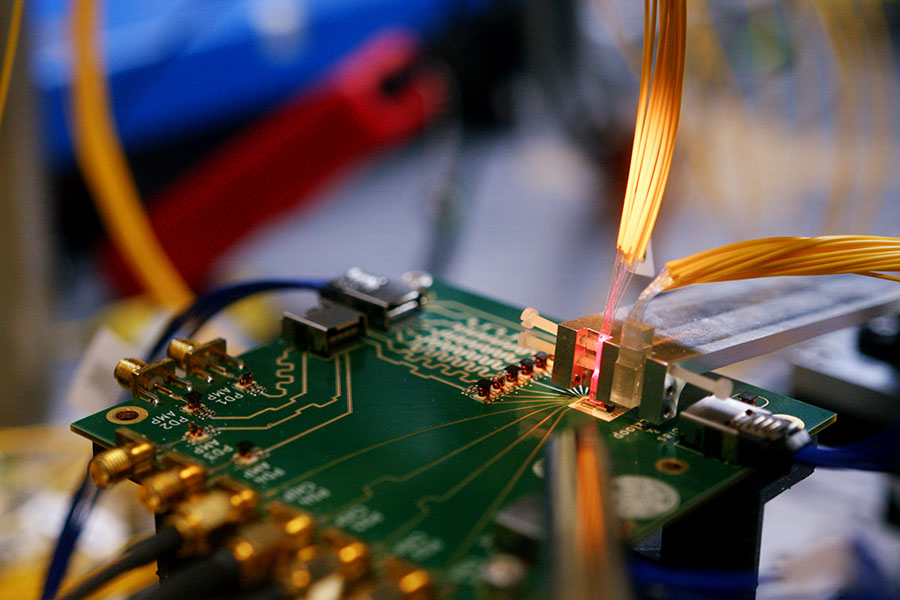
Experiment with photonic chips: Neural structures are grown directly onto the chip and stimulated selectively using light, in order to integrate their natural 3D architecture into artificial systems.
Pernice knows Klingauf, as he himself conducted research at the University of Münster from 2015 to 2023. He was then appointed to the Kirchhoff Institute for Physics at the University of Heidelberg. The project, which began in 2019, is now continuing at both locations: "The research is mainly carried out in Heidelberg. We build the chips in Münster."
The vision is to develop hybrid computing systems that combine the advantages of both worlds – the biological and the technical: the highly interconnected 3D architecture of brain cells with quantum-photonics data processing at the speed of light.
When straying from the path, you may stumble upon unknown effects that could lead to entirely new technologies.
Such systems could not only make prosthetics more flexible and AI more energy-efficient. They could also help quantum computers achieve a breakthrough and facilitate data encryption. It may even be possible to use them to bypass damaged nerve tissue, to help people with spinal cord injuries get back on their feet.
Pernice stresses, however, that there is still a very long way to go. Nor can it be ruled out that chips containing living neurons might not ultimately work as well as hoped. But even then, the effort would not have been in vain: "We are learning so many valuable things from this project that will help us in other areas too, so it is definitely worth it." That, too, is part of the nature of basic research: "Even when straying from the path, you may stumble upon unknown effects that could lead to entirely new technologies."