Academic Freedom Index – 2026 Update. Friedrich-Alexander-Universität Erlangen-Nürnberg (FAU) and V-Dem Institute
Academic Freedom Index: The Autonomy of Universities in the USA Falls Far Behind Peer Group
The new Academic Freedom Index (AFI) report provides an overview of the state of academic freedom worldwide. The data suggests a link between the institutional autonomy of universities and the individual freedom of researchers. In the US, a comparative analysis reveals a dramatic decline in university autonomy.
In spring 2026, the Academic Freedom Index again highlights the global state of academic freedom – new data from the AFI project, carried out by researchers at Friedrich-Alexander University Erlangen-Nuremberg (FAU) and the Varieties of Democracy (V-Dem) Institute at the University of Gothenburg, is published annually in March. The Volkswagen Foundation has been supporting the AFI since 2021.
The State of Academic Freedom 2025
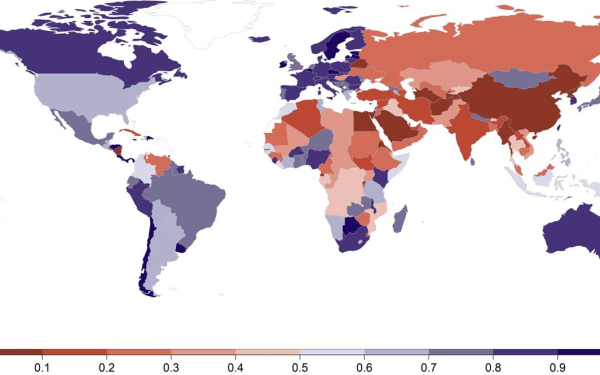
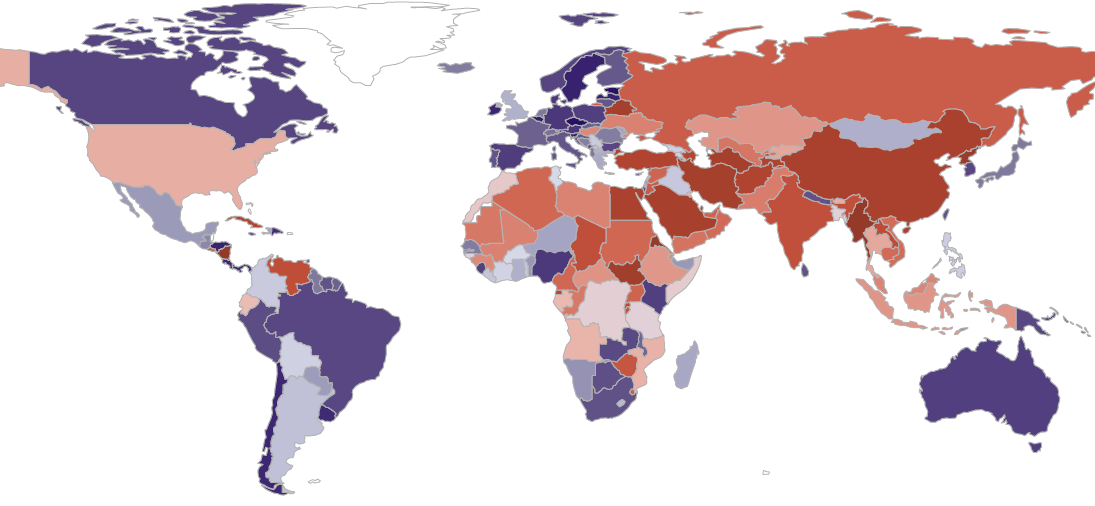
Academic freedom continues to decline worldwide. Over the last decade, it has declined in 50 countries, while only 9 countries have registered improvements. The countries that have experienced a decline include several democracies, such as the United States of America (USA), Greece, Finland, and Argentina.
Globally, the most widespread declines are in individual academic freedom and in campus integrity. By contrast, fewer countries are experiencing declines in institutional autonomy.
Institutional Autonomy in a Global Context and in the West
Between 2015 and 2025, institutional autonomy declined in 43 countries, 21 of which are primarily located in Europe, North America, and Latin America. This trend signals a concerning erosion of university autonomy within liberal democracies, for example in Canada, the Netherlands, Switzerland, and the USA, albeit to very different degrees.
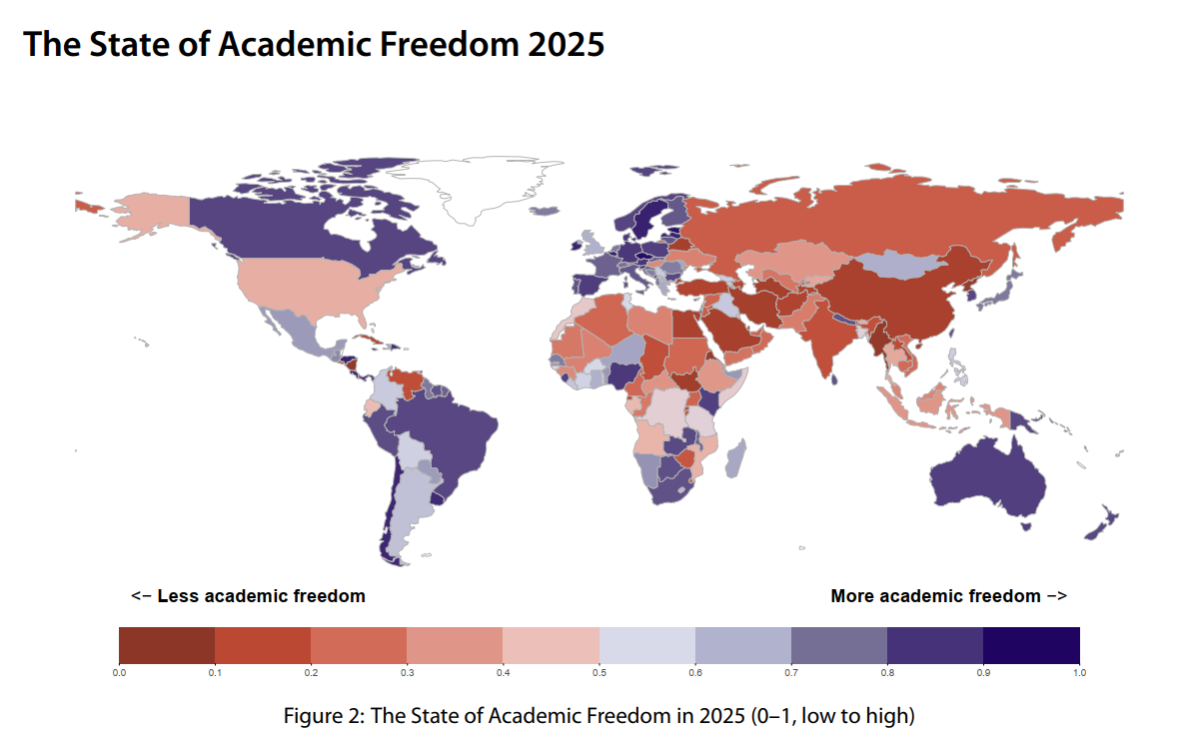
The chart illustrates the actual level of academic freedom worldwide in 2025 (0–1, low to high).
Institutional autonomy plays a central role in protecting academic freedom. Although some scholars and political actors have recently argued that strong institutional autonomy might foster universities that suppress viewpoint diversity, the AFI data indicate a positive correlation between institutional autonomy and the freedom to research and teach. Higher education institutions with greater autonomy tend to provide more robust safeguards for academic freedom at the individual level. Conversely, when institutional autonomy is weakened, both universities and individual scholars become more vulnerable to non-academic pressures.
University autonomy in the USA
This year’s AFI Update presents data on the trajectory of institutional autonomy in the USA and compares the data with the regional averages for Western Europe and North America between 2015 and 2025. The analysis shows that the autonomy of universities in the USA has fallen far behind their peer group.
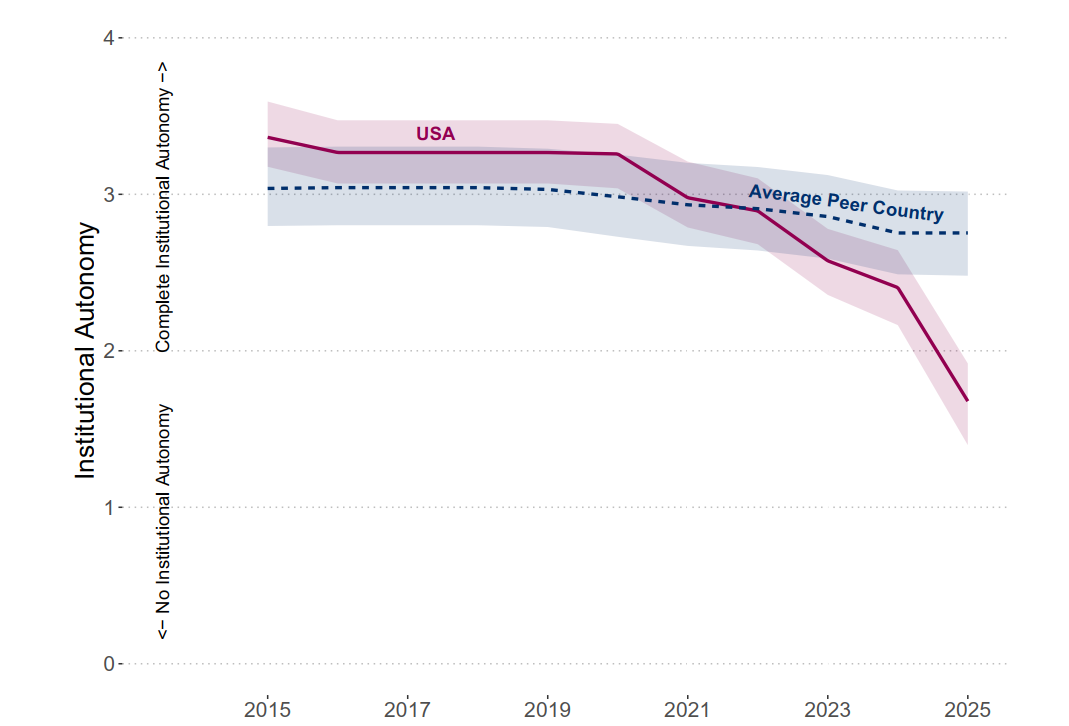
The development of institutional autonomy in the USA and in a typical comparable country in Western Europe and North America between 2015 and 2025.
The decline in the USA has been comparatively abrupt, with institutional autonomy falling from 2.4 in 2024 to 1.7 in 2025 (on a scale from 0-4). This significant drop in just one year was driven mostly by coercive federal actions. The decline first started in 2020 due to state-level measures that have continued to put universities under pressure. In 2019, the score for institutional autonomy in the USA was still 3.3, a comparatively high score in both global and regional comparisons.
Academic Freedom Index database
The data used for the 2026 AFI update (V-Dem dataset) is freely available for use in further studies. The Academic Freedom Index website features an interactive visualisation of the data, country profiles and further information on the index project; the report itself is available as a PDF on the AFI website.
Press release
Here you can find the press release from FAU Erlangen-Nürnberg dated 17 March 2026: "The Autonomy of Universities in the USA Falls Far Behind Peer Group"