
Global Engagement: Guideline, Focus, and History
#Global Engagement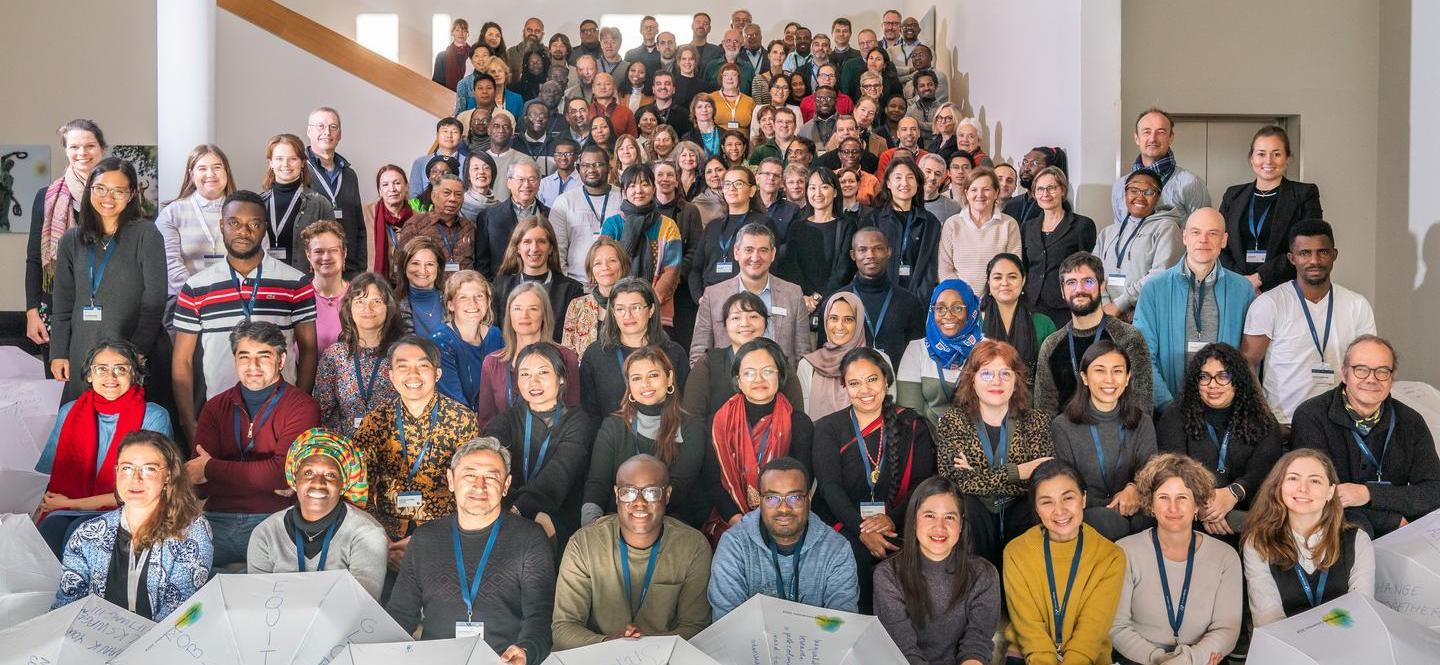
Christian Burkert für VolkswagenStiftung
Participants at the Global Issues Convention 2024 at Herrenhausen Palace, Hanover
To adequately address the tension between opportunities and risks of international academic cooperation in times of global political upheaval and increasing fragmentation, we base our international funding activities on our guideline and four key areas of action.
Global engagement has always been and remains an integral part of the foundation's funding activities. This is enshrined both in the preamble to the foundation's statutes – "It promotes [...] international scientific cooperation" – as well as in the key guidelines for funding activities: "The foundation helps to overcome borders between academic disciplines and research fields as well as between countries and cultures."
We shape our global engagement in a goal-oriented, responsible and flexible manner!
This guideline and the priorities derived from it are translated into needs-based measures in line with the strategic goals of our four profile areas. In so doing, the foundation draws on a variety of tried-and-tested funding formats, but also develops innovative formats based on its many years of experience and – where appropriate – in cooperation with other stakeholders and partners. The goal is always to provide pioneering stimuli.
We specifically evaluate our activities to determine whether they contribute to, for example,
- stabilizing and building global science networks in times of crisis,
- strengthening European cooperation,
- maintaining close scientific relations with the US, and
- supporting scientists in times of crises and emergencies.
By fostering scientific excellence, we aim at contributing to resilient science and the development of evidence-based, sustainable solutions to current global challenges.
Shaping global engagement:
A close-up of our guideline
- Goal-oriented
Our international funding activities are not an end in themselves. Rather, they are guided by our strategic guidelines and the objectives of our four profile areas Exploration, Societal Transformations, Understanding Research, and zukunft.niedersachsen. - Responsible
We are committed to the highest scientific quality and ethical standards. Our funding activities clearly align with our fundamental democratic values and academic freedom (preamble to the statutes: "The foundation is committed to academic freedom and to ensuring the highest scientific quality and integrity"). - Flexible
We refrain from setting rigid red lines regarding specific scientific regions. Instead, we also seek to establish cooperations with scientists in challenging political contexts or in societies with authoritarian tendencies by means of flexible, country-specific solutions on a case-by-case basis – without, however, neglecting the respective political and economic conditions, potential areas of conflict, or risks of abuse.
Four foci: Status quo and future prospects
The four foci of our global engagement are
-
Foundation networks and cooperations
-
International, academic cooperations to build mutual trust
-
Competence building to deal with disruptive changes
-
An open, cosmopolitan discourse
1. We intensify networks and cooperations with global partners.
The foundation is part of renowned international networks for the promotion of science for many years, including the Research on Research Institute (RoRI) and the Philanthropy Europe Association’s PHILEA Research Forum. In addition, it has gained extensive experience in collaborating with other European foundations through various funding programmes over the years.
We want to strengthen this cooperation and exchange between foundations, research funders, and other relevant actors. Most of all, we want to accentuate goal-oriented coordination within Europe. To this end, we want to:
- continue existing collaborations and develop new formats for cooperation with partner foundations,
- pursue participation in foundation networks, for example in areas such as impact evaluation and the use of AI in funding activities,
- intensify our participation in cross-sector, topic-related working groups.
2. We strengthen international academic collaborations and mutual trust.
International cooperations have always been a crucial part of our funding activities. However, the specific forms of these collaborations have varied over the past decades. Concurrently, many calls address international consortia, and international cooperation is standard in many of our initiatives and programmes. Here, we strive to establish international scientific cooperation ‘on eyesight’ and to contribute to capacity building, especially in countries of the so-called Majority World.
We believe that reliable international relationships at all academic levels contribute to the excellence of science in Germany, to the structural improvement of the German science system, and to social progress and innovation. Such relationships are based on mutual trust, which can only be built up over the long term. That is why, especially in disruptive times, we want to maintain and expand trusting, civil society communication and support channels – and thus also strengthen understanding for different scientific cultures.
3. We support scientists to effectively deal with disruptive change.
The foundation has previously initiated funding programmes during times of significant geopolitical change. The goals were to contribute to overcoming the respective challenges and helping scientists to acquire relevant competences to deal with them.
The current geopolitical and science policy environment requires scientists to respond in new ways that are flexible, rapid, and experience driven. To be able to do so, scientific expertise and sound methodological, analytical, and theoretical skills are indispensable. We want to support scientists in acquiring these skills and enable them to deal with disruptive change so that they can make evidence-based contributions to solving global challenges. We consider this support particularly important for early-career researchers. Further, we aim at helping them to build up resilient global networks and plan their careers in a sustainable way.
4. We provide space for global exchange.
At the foundation’s event location Herrenhausen Palace, we regularly bring together international scientists from all disciplines and successfully involve citizens in debates on the key challenges of our time.
We aim at strengthening the foundation's role as a convener – not only, but also on its own premises – to promote a constructive and open, cosmopolitan discourse and dialogue. To this end, we establish needs-based, target group-specific (dialogue) formats with other stakeholders and actors, if appropriate. In so doing, we strive to make the findings of international cutting-edge research accessible to a wider audience and to raise the awareness that many of our current challenges require global perspectives and can only be solved through cross-border cooperation.
History
Since the beginning of its funding activities, the foundation has attached particular importance to international cooperation(s) in various ways.
- During the 1960s, the foundation supported the first scientific cooperations between Germany and Israel, even before the two countries established official diplomatic relations.
- Between 1964 and 1987, the foundation initiated funding programmes for international cooperations with regions such as East Asia, Latin America, the Near and Middle East, Southeast Asia, and North America.
- During the following decades (1980s and 1990s) the foundation put a strong focus on academic cooperation between China and Germany.
- In the early 1990s — after the collapse of the Soviet Union — we, as foundation, launched several programmes to promote cooperation with scientists in Central and Eastern Europe.
- At the turn of the millennium, these initiatives were eventually replaced by funding programmes for cooperations with scientists in the successor states of the Soviet Union in Central Asia/Caucasus and countries in Sub-Saharan Africa.
In 2011 all inter- and transnational activities have been bundled in the former funding team "International Funding". At the same time, global engagement has increasingly manifested itself in all areas of our funding activities: from international expert panels to international review committees – or through intensified cooperations with European and global foundations.
The last projects of our funding initiatives with regional foci on Central Asia/Caucasus and Sub-Saharan Africa are currently coming to an end after a period of around twenty years. The foundation has thus deliberately moved away from regional funding in a classical sense and from its specific 'international funding' team. It has become apparent that international funding integrated into the overall foundation’s strategy allows for more targeted action and greater impact.